

If you wake up at 2 a.m. with your back stuck to the sheet, the fabric you sleep in matters more than anything else on the bed. Between the GYS bamboo viscose nightgown and a plain cotton nightgown, the GYS is the cooler choice for most hot sleepers. It moves moisture away from your skin instead of parking it there, it does not clamp onto your back when you sweat, and it is dry again by morning. The cotton nightgown is cheaper, tougher, and much easier to launder. Weeks of wearing both, on the same bed, under the same sheet, made the difference clear enough that I stopped guessing.
I am 51, I run the front office at an elementary school in Tucson, and my night sweats started around 49. Most nights I wake up hot once, sometimes twice. Ray sleeps cold and likes a heavy blanket, so the thermostat sits around 72 and I would rather it was lower. For years I slept in oversized cotton t-shirts and figured that was as good as it got. I bought two GYS nightgowns in June and have worn them almost every night since, and I wore a cotton nightgown the same way in the same bed, so this is not a comparison I ran in my head while folding laundry.
The Comparison at a Glance
| GYS Bamboo Viscose Nightgown | Cotton Nightgown | |
|---|---|---|
| Fabric and first feel | Bamboo viscose, smooth and fluid, cool against the skin when you first get in | Cotton, soft but with more body and more weight |
| Sweat at 3 a.m. | Keeps moisture moving, stays loose instead of clinging when you wake up damp | Absorbs the sweat and stays damp, sticks flat to your back |
| Dry time after washing | Hangs dry overnight on a hanger | Takes a day or more, longer for a thick cotton |
| Weight on your skin | Light enough that you forget it is on, no waistband digging in | Heavier, more substantial, more fabric to move around at night |
| Laundry and care | Gentle cold wash, hang to dry, keep it out of the dryer | Machine wash and dry with the towels, no special handling |
| Durability over years | Thinner viscose, can pill and wear at the seams with repeated heat | Cotton holds up to years of hot washes |
| Cost up front | Costs more than a basic cotton nightgown | The cheaper option in this comparison |
| If you sleep cold | Very little insulation, you will want a blanket | More warmth on its own |
| Best for | Hot sleepers, night sweats, warm bedrooms | Cold sleepers, tight budgets, rough laundry habits |

How I Tested Them
Testing sleepwear is not a lab experiment. Nobody can hand you a number for how a nightgown feels at 3 a.m., and anyone who does is selling something. What you can do is wear one for a week, switch, and pay attention to the two things that actually wake you up: damp fabric against your back and heat trapped under the covers.
My setup stayed the same the whole time. Same queen bed, same sheets, same small fan on the nightstand pointed at my pillow, same thermostat setting around 72 because Ray gets cold. I wore the GYS for a week, then the cotton for a week, then switched back and did it again. I noted three things each night: how the fabric felt at 10 p.m. when I got in, how it felt when I woke up hot, and how long it took to stop feeling damp afterward.
The first week was the honest one, because I had already spent two months changing everything else. I had swapped my old percale sheets for a brushed microfiber set back in May, and I had a cooling pillow under my head by late May. So by June, the nightgown was the only variable left. That is not a tidy experiment, it is just what happens when you fix a bedroom one piece at a time and then run out of pieces.
The cotton nightgown I compared it to is an ordinary one, the kind of basic cotton sleepwear that Hanes and every other basics brand sells in a three pack. Nothing wrong with it. It is the standard, and most women already own something like it, which is exactly what makes it a fair comparison rather than a straw man.
The difference at 3 a.m. is not temperature. It is whether the fabric against your back feels wet.
Where the GYS Nightgown Wins
The first thing you notice is how little it weighs. Bamboo viscose is a soft, fluid fabric that hangs instead of sitting on you, and when you get into bed it feels cool for the first minute or two. That is not a treatment or a coating. It is a thin, smooth fiber that moves moisture instead of holding it in one place, and you feel that most in the places you sweat first, which for me is the lower back and the back of the neck.
The second thing you notice is what happens when the sweat actually starts. With the cotton nightgown, I would wake up with a wet patch across my lower back and the fabric glued to it, and moving made it worse because the damp fabric came with me. With the GYS, the fabric stayed loose. It felt damp for a few minutes and then it did not. That is the whole difference between lying there awake, peeling a nightgown off your back, and rolling over and getting back to sleep.
I timed it once, mostly out of stubbornness. A Tuesday in late June, woke at 1:40, and the damp feeling across my lower back was gone in what felt like under ten minutes. The same wake-up in the cotton nightgown on a comparably warm night in early June and I was still aware of it at 2:30. That is not a measurement anyone should put on a chart. It is just the reason I stopped wearing the cotton one on nights I could feel the heat coming on before bed.
The cut does its part. Short sleeve, V-neck, falls above the knee, pulls on over your head, no buttons and no zipper to fight at midnight. There is no waistband digging into your hip and no extra fabric bunched around your middle. The back has a lace panel, which means a strip of my upper back has one less layer of fabric lying flat against it. Small thing. On a hot night, the small things are the whole thing.
It also travels well, which I did not expect to care about. Two of them take up less room in a suitcase than one cotton nightgown, and they dry on a hanger in a hotel bathroom overnight. If you are visiting family in August and their guest room has one window and no fan, that matters.
Where the Cotton Nightgown Wins
Start with the honest part. Cotton is cheaper. Not a little cheaper, either. You can buy a basic cotton nightgown for noticeably less than the GYS, and if money is tight this month, that is a real consideration and there is no shame in it.
Cotton is also tougher. I can wash the cotton nightgown in warm water with the towels, throw it in the dryer on medium, and it comes out the same as it went in. The GYS gets a cold gentle cycle, a mesh bag, and a plastic hanger. If you are the kind of person who starts laundry at 11 p.m. and wants to be done with it, cotton forgives you and viscose does not. Heat is what wears viscose out, so every hot dryer cycle shortens its life a little.
I learned that one the ordinary way. The first GYS went into the dryer in July because I was tired and the towels were already in there, and it came out with a soft fuzz across the seat and a slightly shorter hem than the second one. Not ruined. Just visibly older than its twin after one cycle. Since then both go on a hanger in the laundry room and neither has changed again.
And if you sleep cold, cotton has more warmth to it. It has more body, it feels more substantial, and on a cool night that is comforting rather than suffocating. Ray would probably prefer it. He is the one under a fleece blanket in July while I have the fan pointed at my chest.
If you wake up damp more nights than not, start here
The GYS bamboo viscose nightgown is what I reach for when I can feel the heat coming on. Light, loose at the waist, dry again by morning. Cold wash, a hanger, done.
Amazon Check Today's Price on Amazon →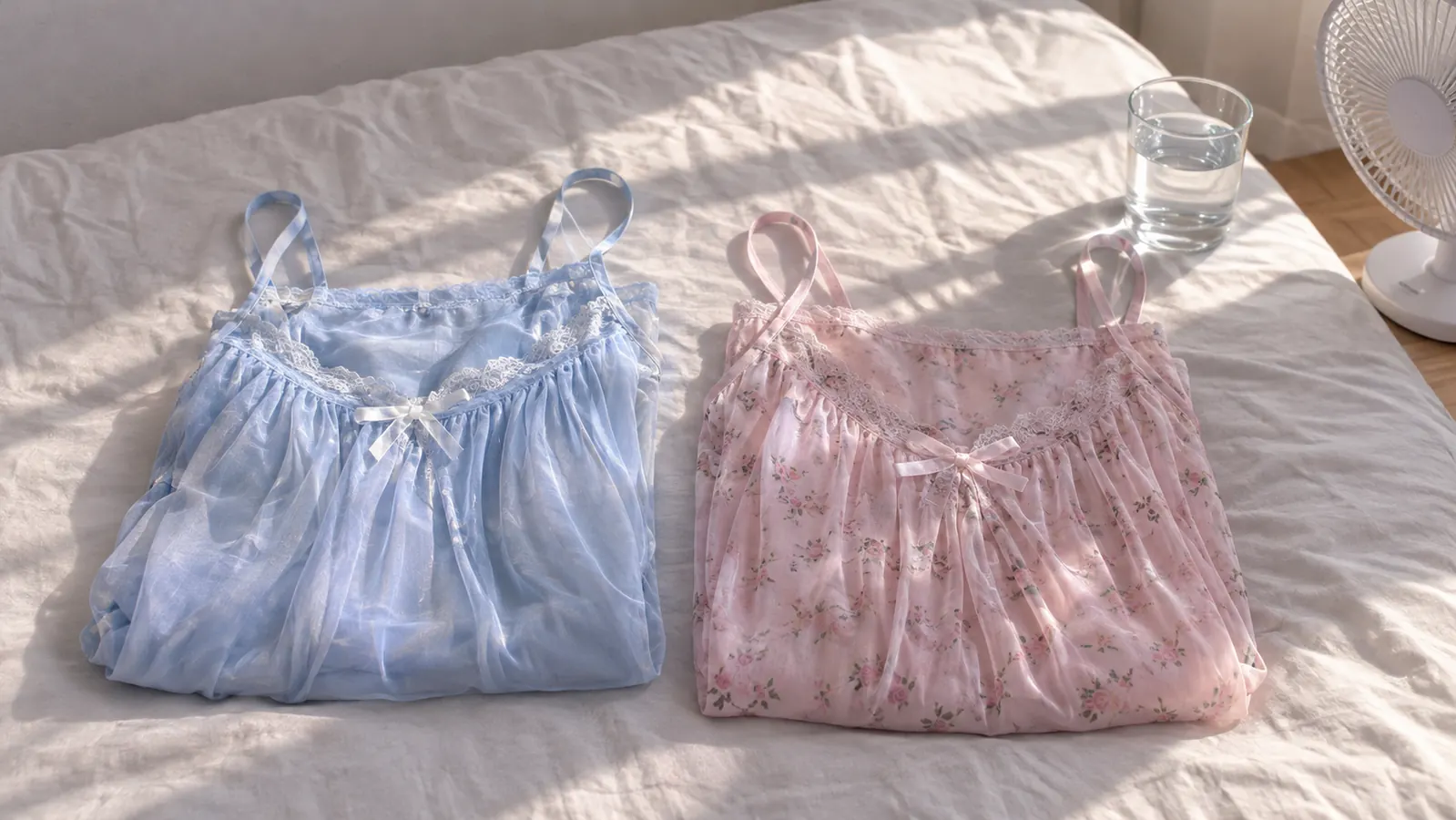
What Bamboo Viscose Actually Is
Bamboo viscose is not the same thing as cotton, and it is not the same thing as the bamboo sheets sold with a lot of promises attached. It is a fiber made by breaking bamboo pulp down and extruding it into strands, which is why the label usually says viscose rather than bamboo. What you get for your money is a fabric that is smooth, absorbent, and light, with a drape that cotton does not have.
The practical part is this: it moves moisture well and it does not hold a stiff shape. That is why it feels cool at first touch, why it hangs instead of clinging, and why it is not the fabric you want to wash on hot with the towels. None of that is a health claim. It is how the fabric behaves, and how it behaves is what you notice at 3 a.m. when you are deciding whether to get up and change.
One more thing worth knowing before you buy: viscose wrinkles if you wad it up wet, and it holds a crease. I hang mine straight from the washer with a shake, and by morning the creases have mostly fallen out. If you leave it in a damp pile in the basket overnight, you will be ironing a nightgown, which is a sentence I never expected to write.
What Neither Nightgown Does
Neither nightgown stops a night sweat. No fabric does. What a cooler nightgown can do is keep you from lying in a puddle of your own sweat once it happens, which is a smaller promise and an honest one. It buys you comfort in the moment. It does not regulate your body for you and it does not fix the underlying reason you are running hot.
If you are waking up soaked several nights a week, changing sheets at 3 a.m., or your sleep is falling apart in a way that is affecting your days, that is a conversation for your doctor, not a shopping decision. I have had that conversation myself. Perimenopause symptoms are worth treating properly, and a nightgown sits near the bottom of that list, not the top.
How I Care for the GYS
Gentle cold wash, mesh bag, hang to dry. That is the entire routine. It goes in with my delicates, comes out on a plastic hanger in the laundry room, and is dry by the next evening. I have two, so one is always clean while the other dries, which is the real reason I bought a second one.
The cotton nightgown goes in with the towels on warm and straight into the dryer. I am not gentle with it and it does not care. If you want a nightgown you can treat badly and never think about again, buy the cotton one and save yourself the fuss.
Who Should Buy Which
Buy the GYS if you wake up hot once or twice a night, if your bedroom holds the afternoon heat, if your partner keeps the thermostat higher than you would like, or if you have ever peeled off a sweaty t-shirt at 1 a.m. and wished you had something lighter to put on. That last one is not hypothetical for me. It is the night I ordered the first one.
Buy the cotton nightgown if you sleep cold, if you want to spend as little as possible, if your laundry routine is hot water and a dryer and you have no plans to change it, or if you are buying sleepwear for one season and do not need it to last five years. It is a perfectly good nightgown. It is just not the one that helps when your body is already running hot.
And if you are on the fence, buy one GYS and keep the cotton you already own. That is exactly what I did. The cotton nightgown is still in the drawer. It just does not get picked first anymore.
The one I reach for at 10 p.m. on a warm night
Two GYS nightgowns in rotation since June. Light enough that I forget I am wearing it, loose enough that a sweat does not glue it to my back, and quick to dry on a hanger. If your nights look like mine, this is the place to start.
Amazon Check Today's Price on Amazon →