

Ray sleeps under a fleece blanket in July. I sleep with one leg out from under everything and a small fan pointed at my pillow. We have been married twenty-seven years and we have never once agreed on the temperature of a bed.
That is the real problem, and it is not the one anybody talks about. A hot flash is miserable on its own, but a hot flash in a bed you share with a man who gets cold at 72 degrees is a different kind of miserable. Turn the thermostat down and he wakes up shivering. Leave it alone and I am awake at 2 a.m. with the back of my neck damp and the fitted sheet stuck to my hip. So I stopped trying to win the thermostat argument and started changing the bed instead. The first layer I changed, back in early May, was the sheets. I bought a queen set from CGK Unlimited, four pieces, and that one purchase did more for my nights than anything else I have tried this year.
The layer your skin is actually against at 2 a.m.
CGK Unlimited makes a four piece queen set: flat sheet, fitted sheet, two pillowcases, with pockets that take a mattress up to about 16 inches. It is the cheapest part of the bed to change and the part your body spends all night touching.
Amazon Check Today's Price on Amazon →Step 1: Change the layer that touches your skin first
Most people start in the wrong place. They buy a fan, or a topper, or one of those pads you put under the fitted sheet, and they never touch the thing their skin is against for eight straight hours. Start with the sheet. Everything else is downstream of it.
Our old sheets were cotton percale. I loved them for about ten years. Percale is crisp and it breathes, and for the first hour of the night it is genuinely good. The problem was hour four. Somewhere around 3 a.m. they would feel damp and clingy, and once a percale sheet feels damp it stays that way until morning. Cotton is built to hold moisture. That is what makes it comfortable in the daytime and what makes it a problem at 3 a.m.
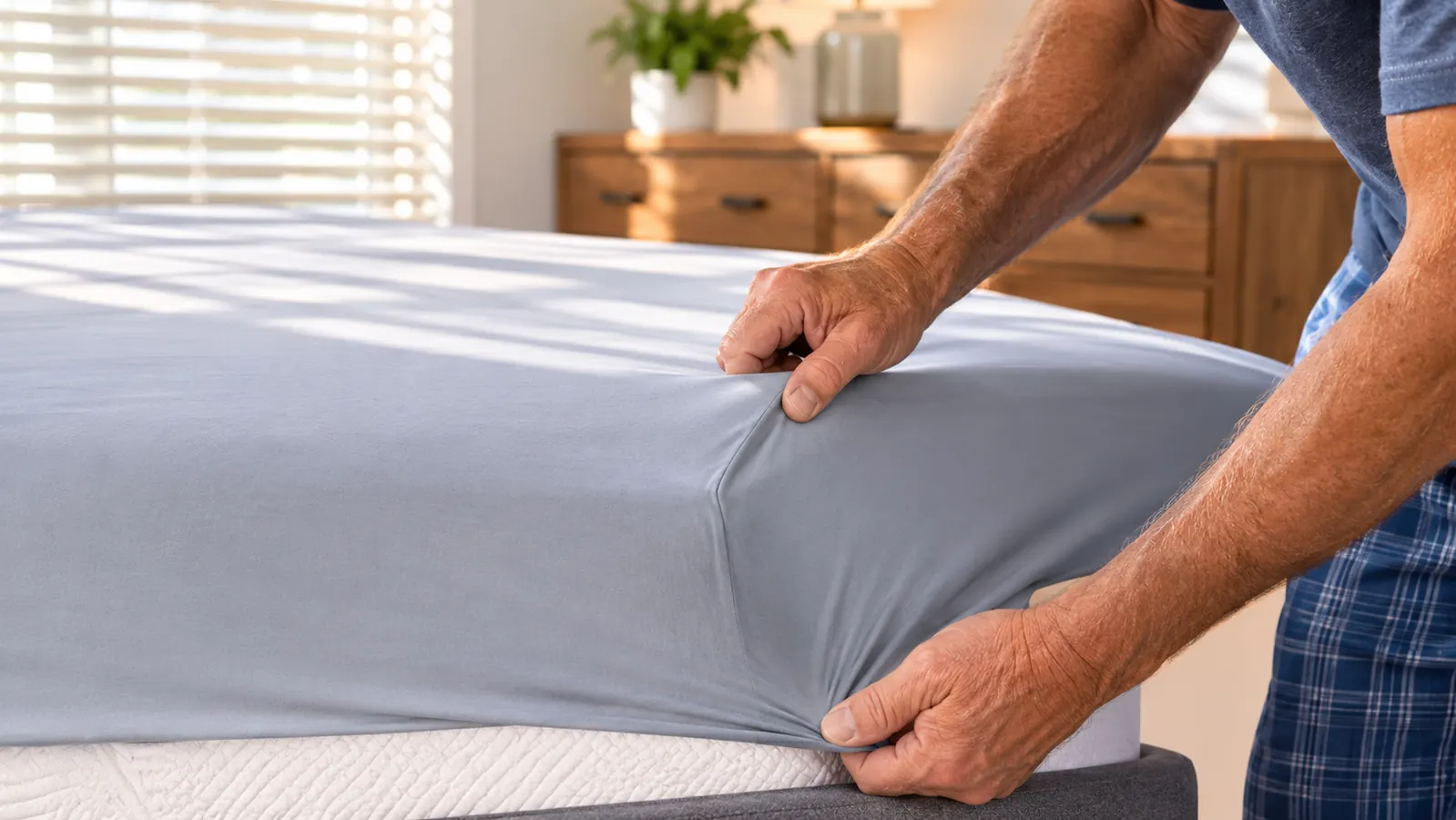
The CGK Unlimited set is brushed microfiber, which is polyester, and I want to be straight about that because it matters. It is not cotton and it does not pretend to be. What it does is feel smooth and light rather than crisp, and it does not hang onto dampness the way the percale did. I noticed it in the first week. I would wake up at the usual time, and the sheet under me felt like a sheet instead of a warm towel.
The set is four pieces: a flat sheet at 102 by 90 inches, a fitted sheet at 80 by 60, and two pillowcases at 20 by 30. The fitted sheet has deep pockets that take a mattress up to around 16 inches, and ours is well under that, so the corners stay down all night instead of popping up at the head end. It is wrinkle resistant, which in practice means I pull it out of the dryer and put it straight back on the bed without ironing anything. That has held up through a whole summer of Saturday washes.
Two things I would tell a friend before she buys. Polyester is polyester, and if you have ever hated the feel of a synthetic sheet against your skin, you will notice this one. It is soft, not silky, and it does warm up somewhat overnight. And I own exactly one set. I wash it Saturday morning and put it right back on the bed, so I cannot tell you how a second set wears over a year. One set, every night since early May, is what I actually know.
Percale felt cool for about an hour. Somewhere around 3 a.m. it felt damp, and once a sheet feels damp it stays that way until morning.
Step 2: Give each side of the bed its own top layer
A comforter is a shared object, and shared objects share heat. If Ray is under a down alternative comforter and I am under the same comforter, then his body heat becomes my problem at about the same time every night. This sounds obvious. It took me years to actually fix it, because a made bed with two different blankets on it looks odd, and I cared about that more than I cared about sleeping.
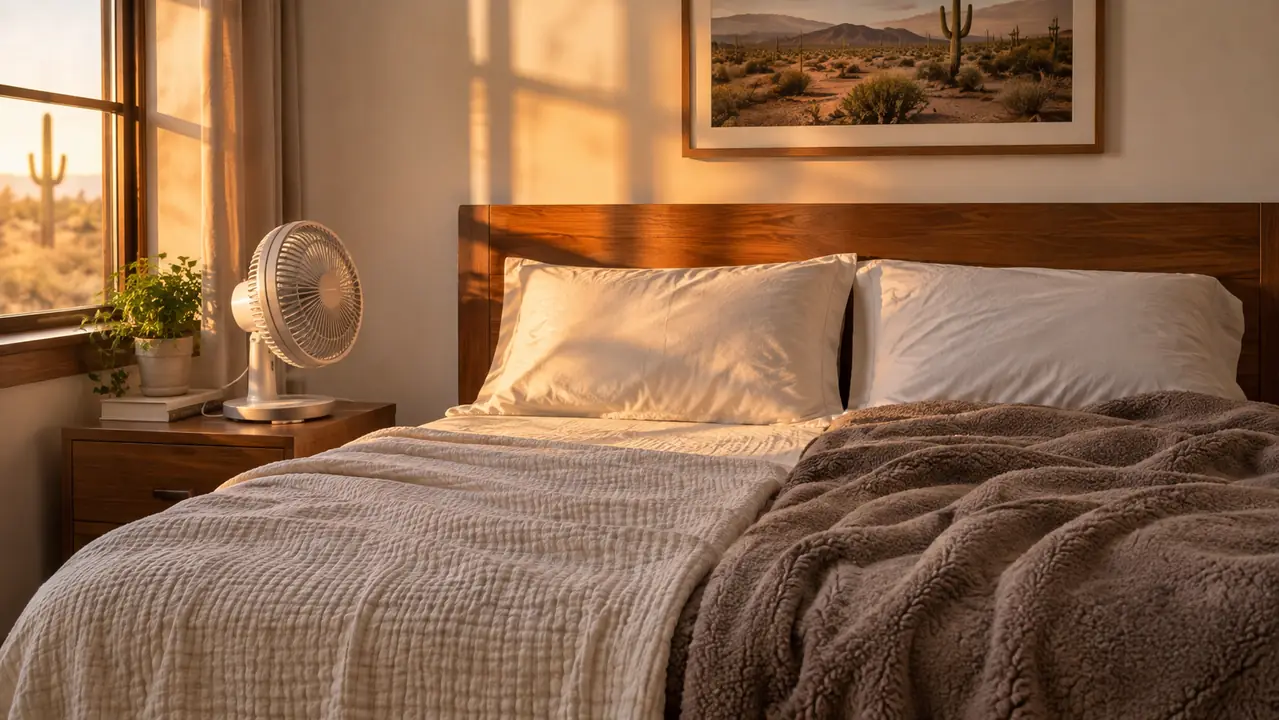
What works for us is a split top layer. The flat sheet is the shared layer, and it is thin enough that it does not trap much. Above that, the bed has two climates. Ray keeps his heavy fleece blanket on his half. I fold a lightweight blanket in half lengthwise so it covers only my side, and on most nights I end up pushing it down to my waist by midnight anyway. Nobody's feet are cold and nobody is bailing out of bed at 2 a.m. to stand in front of the hallway vent.
If you do not want to buy anything at all, start with what is already in the hall closet. Two lighter blankets beat one heavy one almost every time, because the person who runs hot can kick theirs off without uncovering the person who does not. That is the entire principle. The inhand cooling blanket I use is cool to the touch when I first get under it and warms up after a while, and that is fine with me.
One practical note: make the bed in the morning with the split already in place. If you wait until you are overheated and half asleep to go looking for a different blanket, you will not do it. You will lie there and stew. Set the bed up at 8 a.m. for the person you will be at 2 a.m.
Step 3: Move air across your side, not across the room
A ceiling fan cools the whole room, which is not what I need. I need moving air on my neck and my chest for about twenty minutes, and then I need it to keep running quietly enough that I can fall back asleep instead of lying there listening to it.
I keep a small Honeywell TurboForce tabletop fan on my nightstand with the pivoting head aimed at my pillow and my chest, and I run it on low most nights, medium during a hot flash, and almost never on high because I can hear it.
Two things I got wrong for a long time. The first is aiming it at my face, which dries out my eyes and my sinuses and does not actually cool me down any faster. The neck and the chest are where it helps. The second is running it all night on high, which is loud enough that I wake up anyway. Low speed, aimed well, beats high speed aimed at the ceiling.
Air is only half of it. Our bedroom faces west and takes the whole afternoon sun, so by 6 p.m. that wall is radiating heat like a brick oven. I close the blinds on that side by two in the afternoon now, every day from May through September. No fan made can outrun a wall that has been baking since noon.
Step 4: Stop sleeping on a heat trap
I spent years flipping my pillow over in the middle of the night looking for a cool side, and there never was one. Solid memory foam holds everything you put into it, including body heat, and it holds it for hours. It also holds its shape, which is exactly why it is comfortable in the first place. That is the trade and nobody tells you about it.
The SUPA MODERN shredded memory foam pillow I use has a zipper, and I took out a handful of fill to make mine lower, which puts less of my head and neck in contact with foam.
If you are not replacing a pillow this month, there is still something you can do tonight. A thinner pillow traps less heat than a thick one, so if you have two, take the flatter one. And stop fighting the flip. If you have flipped it three times and it is still warm, the pillow is the problem and no amount of rotating will fix it.
Step 5: Change what you wear before you change the thermostat
For years I slept in Ray's old cotton t-shirts, the oversized ones, because they were soft and I did not have to think about them. They also held sweat like a sponge. At 1 a.m. a damp t-shirt is its own separate problem on top of the heat, and I would get up, change, and then lie there wide awake with my heart going.
What I wear now is a short sleeve bamboo viscose nightgown, and the difference is not that it stops anything. It does not. The difference is that it feels lighter against my skin and it dries faster than the cotton did, so a wake-up is just a wake-up instead of a whole wardrobe change at 1 a.m.
Whatever you sleep in, do one thing for yourself: keep a spare set within arm's reach of the bed. Not in the closet, not folded in the dresser drawer across the room. On the floor next to the nightstand. The goal is to be back under the covers in under a minute, because every minute you spend up and moving around, you are getting more awake and the falling-asleep clock starts over.
And leave the thermostat alone. Ray is an HVAC technician and he has opinions about this, but the useful part is simple. A two degree change at 2 a.m. does not fix a bed that is holding heat, and it does start an argument neither of us will finish. Change the layer, not the number.
What Else Helps
Cool the room before you get into it, not after. I run the fan in the bedroom for half an hour while I am doing dishes, so the air in there has already turned over by the time I go to bed. Same idea with the blinds. Getting ahead of the heat is easier than catching up to it at midnight, and it costs nothing.
Keep water on the nightstand, and keep the room dark enough that a 2 a.m. wake-up does not turn into a 2 a.m. wide-awake. If I check the clock, I start doing math about how many hours are left before 5:45, and that is the end of me. The clock faces the wall now.
Last thing, and I mean this. None of what I have written here is treatment. Sheets and fans and blankets change how a night feels, not what your body is doing. I have talked with my own doctor about my night sweats, and I would say the same to any woman in her forties or fifties reading this. There are real options, and none of them come in a bedding aisle. Deal with the comfort so you can think straight, then deal with the rest with someone who went to school for it.
Start with the layer you cannot kick off
You can push a blanket down and you can turn a fan off, but the sheet is against your skin until morning. CGK Unlimited's queen set comes in four pieces with deep pockets and a wrinkle resistant finish, and it is the first change I would make again.
Amazon See the CGK Unlimited Set on Amazon →