
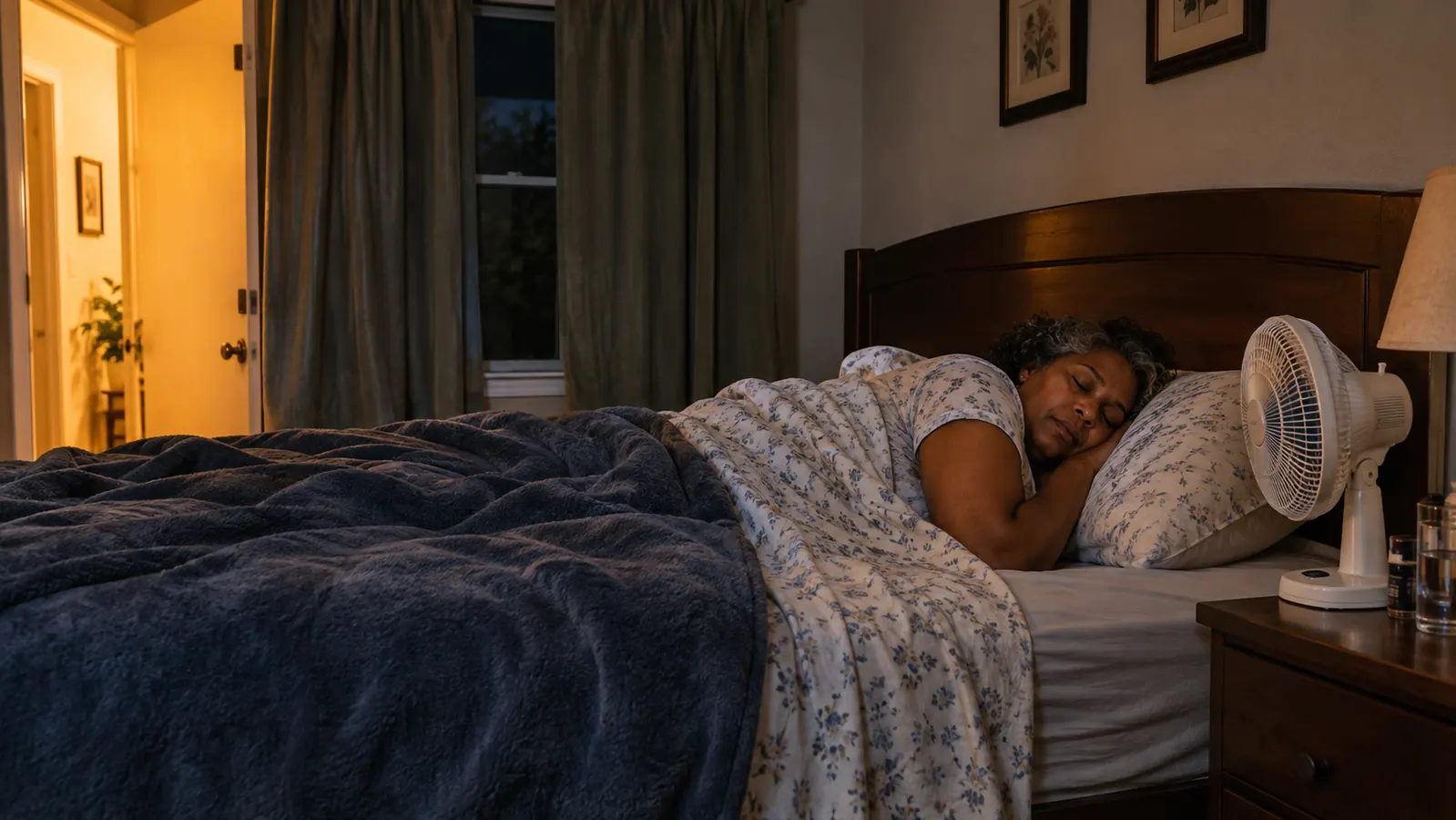
Ray sleeps cold. He is 55, he works in HVAC, and he can tell you the exact spot in our bedroom where the ceiling vent hits the mattress. I sleep hot. My night sweats started around 49 and most nights I wake up once, sometimes twice, with the pillow damp and the covers kicked down to the foot of the bed. For a stretch there we fought over the same comforter like it was the last life jacket on a boat. He would pull it up, I would throw it off, he would wake up cold and walk over and nudge the thermostat back to 72, and I would lie there in the dark feeling like an oven somebody forgot to switch off.
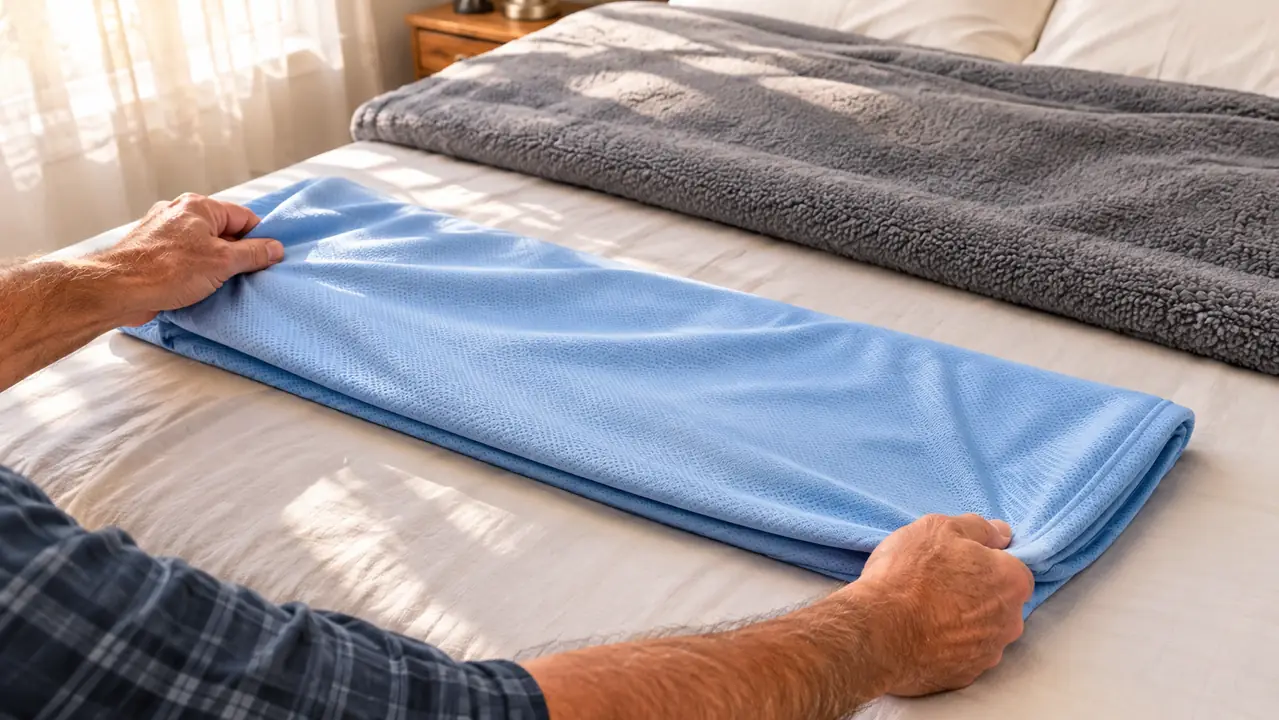
What finally worked was not a new thermostat setting and not a lighter comforter. It was giving up on the idea that two people with opposite body temperatures have to share one top layer. In early July I bought an inhand cooling blanket, the queen size, and I folded it in half lengthwise so it covers my half of the bed and nothing else. Ray kept his heavy fleece on his half. The fighting stopped inside a week. It did not stop my night sweats. It stopped the part where we were both awake because of each other, which turned out to be most of the problem.
The blanket I fold in half and keep on my side
Queen size, 90 by 90 inches, single layer, nylon cooling fabric on the front, machine washable. It is my top layer and Ray's fleece stays on his side.
Amazon Check Today's Price on Amazon →The Setup, in Five Steps
None of this is complicated. It took me three summers to land on it, mostly because I kept trying to fix things by changing the thermostat, which is a two-person negotiation at 2 a.m. and nobody wins those. Here is the order I would do it in if I were starting over, and the parts of it that honestly do not work the way the internet says they will.
Step 1: Give each side of the bed its own top layer
This is the whole trick. One blanket shared by two people who run at different temperatures means one of you is always wrong, and usually it is whoever is less stubborn. So stop negotiating. You get a light, cool top layer. Your partner gets whatever they want, on their side, and you do not touch it and they do not touch yours.
Mine is the inhand queen, 90 by 90 inches, single layer. Folded in half lengthwise it is 45 inches wide. Our queen mattress is 60 inches across, so that 45 covers my 30-inch half with the extra dropping over my edge of the bed, and the remainder lands in the middle on top of Ray's fleece. There is a narrow overlap where the two meet. That seam is where the whole arrangement succeeds or fails. Leave a gap and you will both wake up cold and irritable by morning. Tuck the edges under slightly if you have to.
One note on the folding, because I got this wrong for two weeks. Fold it lengthwise, not across. Folded across, you get a short double layer that quits at your knees and leaves your feet bare, and your feet are the one part of you that still wants a blanket in July. I also tried folding it in thirds once, thinking narrower would be tidier. It slid off my side by 2 a.m. and I woke up under nothing at all. Half is the number. Measure your mattress before you order and you will get this right the first night instead of the third week.
Step 2: Put the cooling layer against your skin, not over the comforter
The first week I tried laying the inhand blanket on top of our old down-alternative comforter, like a topper, thinking that would cool the whole stack. It does not. You are still underneath a comforter and the cool fabric has nothing to do with you. It goes on you. Not over another blanket, not under a sheet.
The first night I used it the right way, I got into bed at 10 like always and it was genuinely cool against my arms and legs, which I had not expected from a blanket with so little weight to it. I woke up hot around 1:40, the way I usually do. But instead of the whole bed being a sauna, it was one patch under my back that had gone warm. I pushed the blanket down, rolled onto the cooler part, and was back asleep before the fan had finished doing its thing. That was the first night in months I did not get up and walk around the kitchen.
And here is the honest part. It warms up. It feels cool when you first get under it, that is real and it is pleasant in a Tucson July, and then after a while it settles into neutral and just feels like thin fabric. It is not refrigerated. If you get in expecting a cold sheet at 3 a.m. you will be disappointed, and you will leave a one-star review, and I will understand why. What it gives you is a dry, light layer that does not trap heat the way the comforter did, plus a fresh cool patch every time you turn over onto an untouched section.
Because it is a single layer, it is also easy to shove off in the night without waking anybody. That sounds like a small thing. In a bed with two people in it, it is not a small thing.
Step 3: Move the air on your side, not the thermostat
For years my answer to a hot night was to turn the thermostat down. Ray's answer was to turn it back up. In late June I set it to 70, he woke up cold and put it back to 72, and I was still too hot under the comforter we were both under. That was the night I ordered the blanket, and it was also the night I stopped pretending the thermostat was going to save me.
The fan handles the air. I have a small Honeywell TurboForce on the nightstand, the little tabletop one, and it points at my pillow and chest. Low almost every night. Medium during a hot flash. High almost never at night, because the noise keeps me up longer than the heat does.
Placement matters more than speed. Mine started out on the dresser across the room and all it did was make noise. On the nightstand, arm's length from my pillow and angled at my chest, it is a different machine entirely. The controls are buttons on the unit itself, so I can find them in the dark without turning on a light or hunting for a remote I do not have.
Keep the thermostat where your partner can live with it and put the air where you need it. A steady stream across your face and chest does more for how a hot night feels than three degrees on the wall ever did. It also keeps a little air moving between you and the blanket, which helps that thin layer stay dry instead of turning damp.
Ray has not touched the thermostat in the middle of the night since July. I still wake up hot maybe once a week. One of those changed my sleep. The other one changed my marriage.
Step 4: Change what is under you and what you wear before you buy anything else
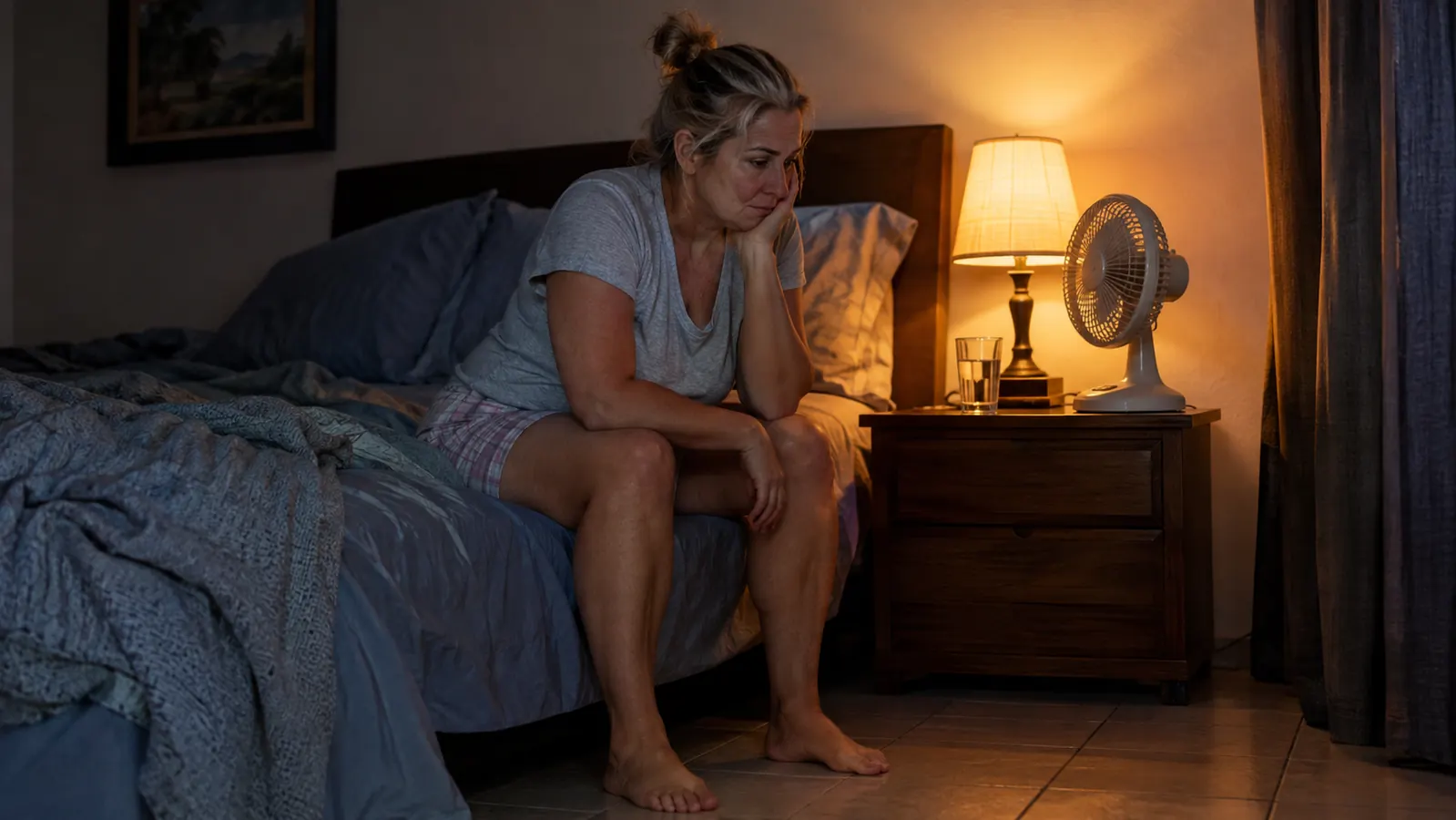
The sheet matters more than I expected. In early May I swapped our old cotton percale for a brushed microfiber set, and I stopped waking up on damp, clingy fabric at 3 a.m.
Same with what I sleep in. In June I moved from oversized cotton t-shirts to a couple of bamboo viscose nightgowns, and they feel lighter and dry faster, which is the only claim I am making about them.
If you are starting from nothing, do it in this order: sheets, then what you wear, then the air, then the top layer. The blanket was the last thing I bought and the one that fixed the most, but it would have done less for me in April, sleeping on damp percale in a heavy shirt with no air moving. Each step makes the next one work better.
None of this stops a night sweat. Nothing I own stops a night sweat, and I would be lying to you if I said otherwise. What it does is shorten the amount of time you spend lying there feeling clammy afterward, and that is the part that keeps you awake for the next hour.
Step 5: Build a boring 2 a.m. routine
When I wake up hot, I used to do everything wrong. I would check my phone. I would get up and turn on a light. I would start a conversation with Ray, who is a saint about it but half asleep and no help. Twenty minutes later I would be wide awake and annoyed.
Now the routine is short and dull on purpose. Fan to medium. Push the blanket down to my waist for a few minutes. Turn the pillow over, because I swapped my old solid foam one for an adjustable shredded memory foam pillow at the end of May and it has a cooling side and a soft side, so there is always a cooler face to find. No phone. No overhead light. No talking. Water from the glass on the nightstand, and back down.
Ray knows the drill by now. If I sit up, he rolls over and says nothing, because we both learned that a conversation at 2 a.m. turns a six-minute wake-up into an hour. It sounds cold, reading it back. It is actually the kindest thing he does for me.
The point is not to make the wake-up disappear. The point is to make it boring enough that your body does not decide it is morning. Mine takes about six or seven minutes now instead of forty.
What Else Helps
Settle the bedroom temperature as a couple, once, in daylight, when neither of you is sweaty and resentful. We landed on 72 because Ray gets cold and I would rather it was lower, and then I solved my side of it with the fan and the blanket instead of reopening the argument every night. We also keep the west-facing curtains drawn through the afternoon in summer, because that room holds the desert heat until well past dark.
The old down-alternative comforter lives on the guest bed now. We tried keeping it folded at the foot of our bed for a week in case Ray wanted extra, and it just ended up on the floor every morning, so out it went.
Wash the blanket regularly. Mine is machine washable and goes in with the sheets on Saturday, and it comes out the same as it went in. A cooling fabric that has been slept against for two weeks is not cooling; it is just fabric.
And talk to your doctor about the night sweats, the waking up, all of it. I talked to mine, and it was worth doing. Comfort in the bedroom is a real thing worth solving and I have spent actual money solving it, but it is not the same thing as treatment, and no blanket on earth fixes a hot flash from the inside. A cooler bed is a cooler bed. That is the entire promise.
One blanket, folded in half, on my half of the bed
Single layer, nylon cooling fabric, 90 by 90 inches, machine washable. It will not stop a night sweat. It will keep you from fighting over the comforter at 2 a.m.
Amazon Check Today's Price on Amazon →