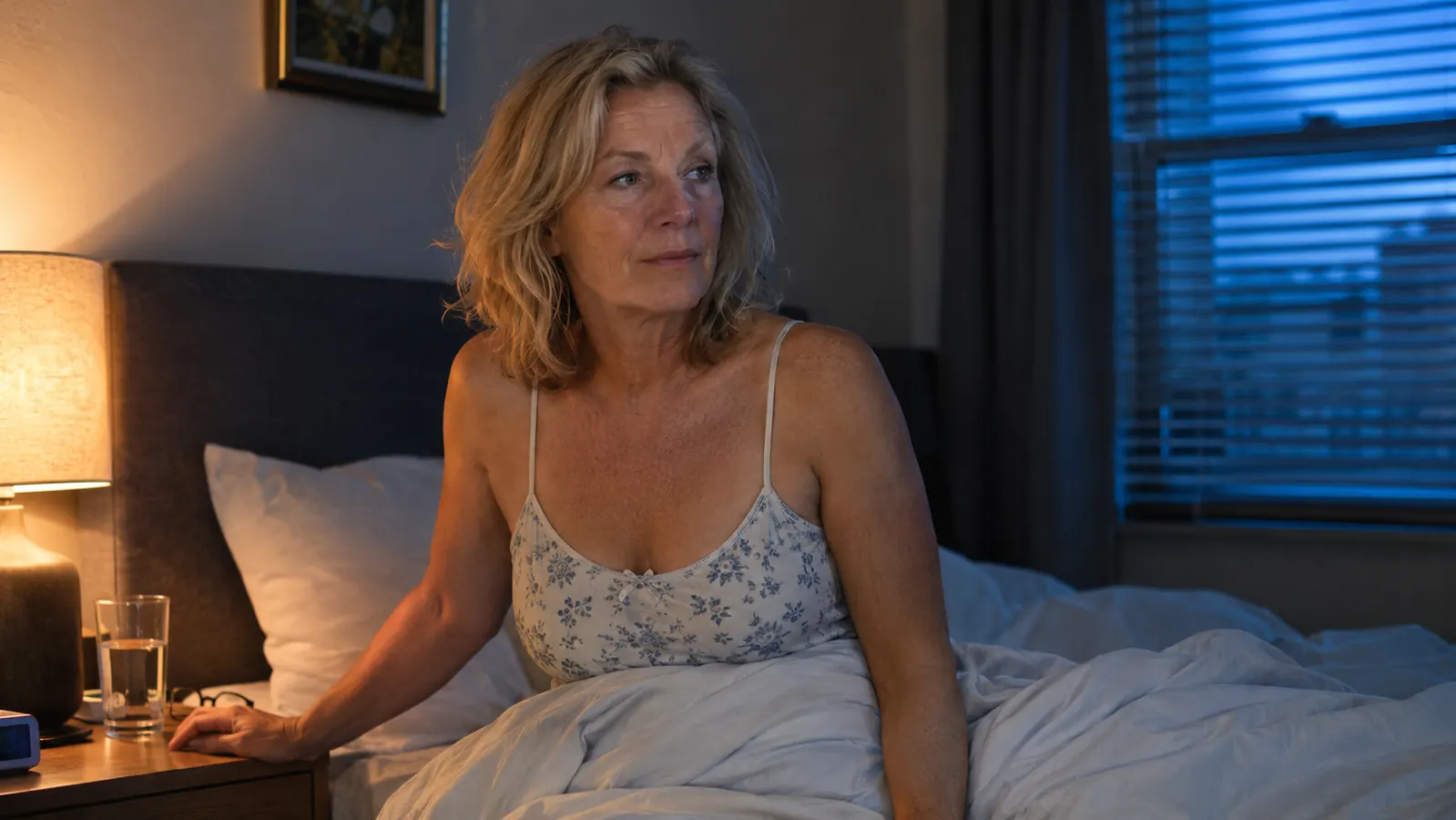
I wake up hot once most nights and sometimes twice. I am 51, I run the front office at an elementary school in Tucson, and my night sweats started around 49. For the first year I handled it the way most people do. I threw the comforter off, lay there until I got cold, dragged it back on, and then did the whole thing again around 4 a.m. By the time my alarm went off at 5:45 I had slept in three separate pieces. What finally helped was not one product. It was five small changes I made in my own bedroom, one at a time, between April and July.
The nightgown mattered more than I expected. I sleep in a GYS bamboo viscose nightgown now, short sleeve with a V-neck, and the difference is boring and practical: it does not hold moisture the way my old cotton t-shirts did. That is not a cure and I am not going to pretend it is. Nothing I own stops a night sweat. But when one hits, the fabric is not making it worse, and that turned out to be most of the battle. Here is the setup, in the order I would do it again if I had to start over.
Start with the layer closest to your skin
The GYS nightgown is short sleeve, V-neck, above the knee, and pulls on over your head without a fight at 2 a.m. It will not stop a night sweat. It just will not hold one against you.
Amazon Check Today's Price on Amazon →Step 1: Change the layer touching your skin before you change anything else
An old cotton t-shirt is close to the worst thing you can wear to bed if you sweat. Cotton takes on moisture and keeps it against you. That is fine when you are awake and moving around. It is miserable at 3 a.m., because the shirt goes from damp to cold and heavy and you wake up colder than you were hot. I slept in oversized t-shirts for years because they were soft and I did not think about it for one minute.
The GYS nightgown is bamboo viscose with short sleeves and a V-neck, and it falls above the knee. It pulls on over your head, so there is no zipper or tie to fight with in the dark. The fabric is thin and light in a way my t-shirts were not, and it dries noticeably faster. When I wake up damp at 1 a.m. now, the gown has already started to dry by the time I have kicked the blanket off. That is the whole claim. It is not a cooling product and it does not stop anything. It just fails less badly than cotton.
I own two and I alternate them. Cold wash, hang to dry, and I do mean hang. Mine go on the back of the bathroom door on a plastic hanger and they are dry by the time I get home from work. Two has been enough because one is always clean and dry. The lace detail on the back is not something I would have picked out myself, but it does not itch and it does not press against the mattress the way a thick seam would.
Step 2: Build a bed you can shed in pieces without waking your partner
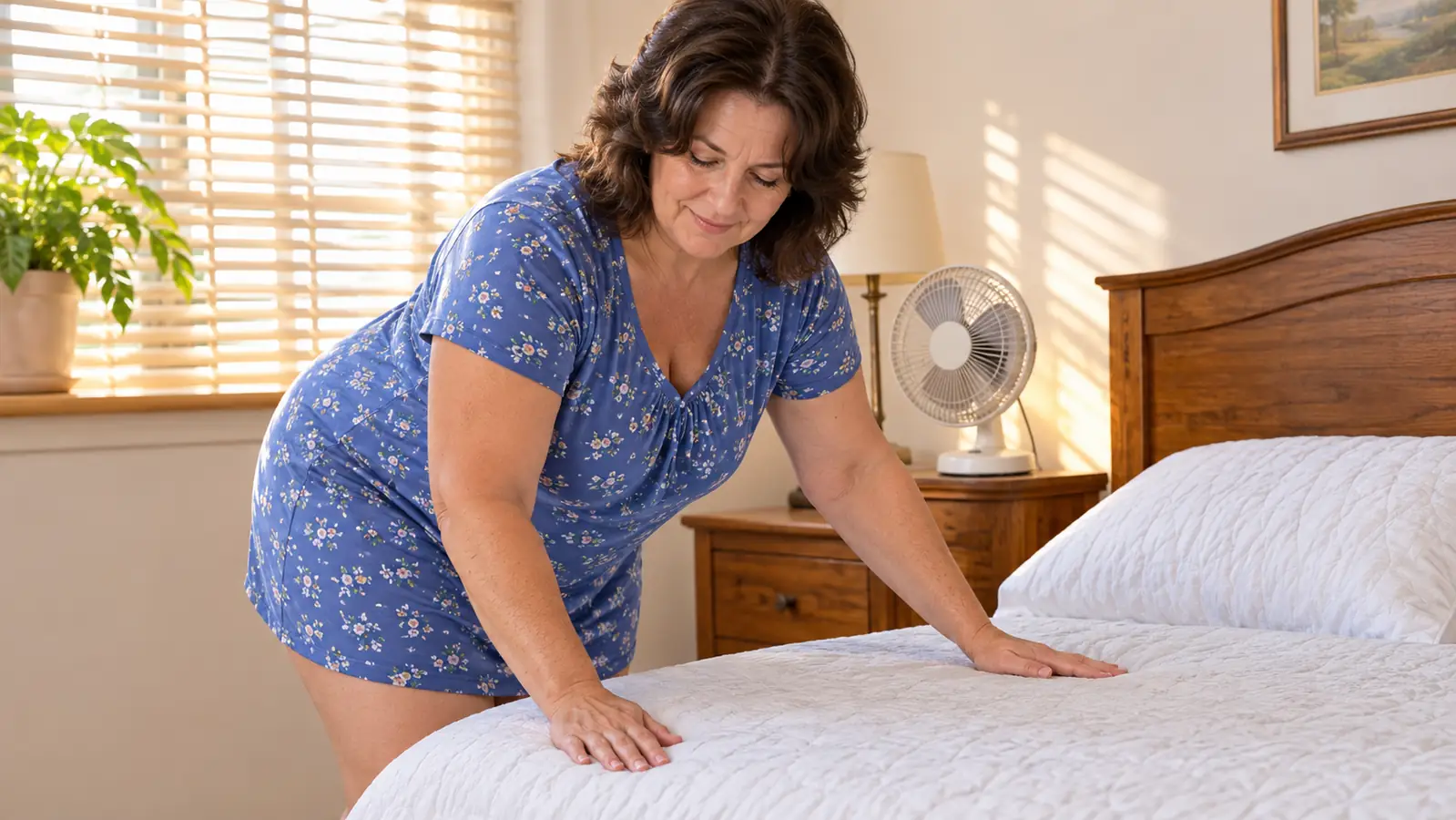
The sheets matter nearly as much as the nightgown, and I did not expect that. The CGK Unlimited set I bought in early May is brushed microfiber, queen, four pieces, with a deep pocket fitted sheet that goes down about 16 inches. It is smooth and light rather than silky, and it does not hold wrinkles, which matters less at 2 a.m. than you would think and more at 5:45 than you would like. I own one set. It goes in the wash Saturday morning and straight back on the bed.
On top, I stopped sharing a comforter. I bought the inhand cooling blanket in early July, queen, 90 by 90 inches, single layer with a nylon cooling side. I fold it in half lengthwise so it covers only my side of the bed, and Ray keeps his own heavy fleece on his side. It is cool when you first get under it and it warms up after a while. Do not buy it expecting it to stay cold until morning. Buy it because it is thin, it comes off with one hand, and it does not trap heat the way a down-alternative comforter does.
That last part is why I stopped fighting the thermostat. Our bedroom faces west and holds the afternoon heat, and the thermostat sits at 72 overnight because Ray sleeps cold. I would rather it was lower. But every time I turned it down, Ray woke up cold and turned it back to 72, and then there were two of us awake at 3 a.m. and one of us annoyed. The layer system fixed that. I control my side of the bed and he keeps his.
Step 3: Move air across your head, not across the whole room
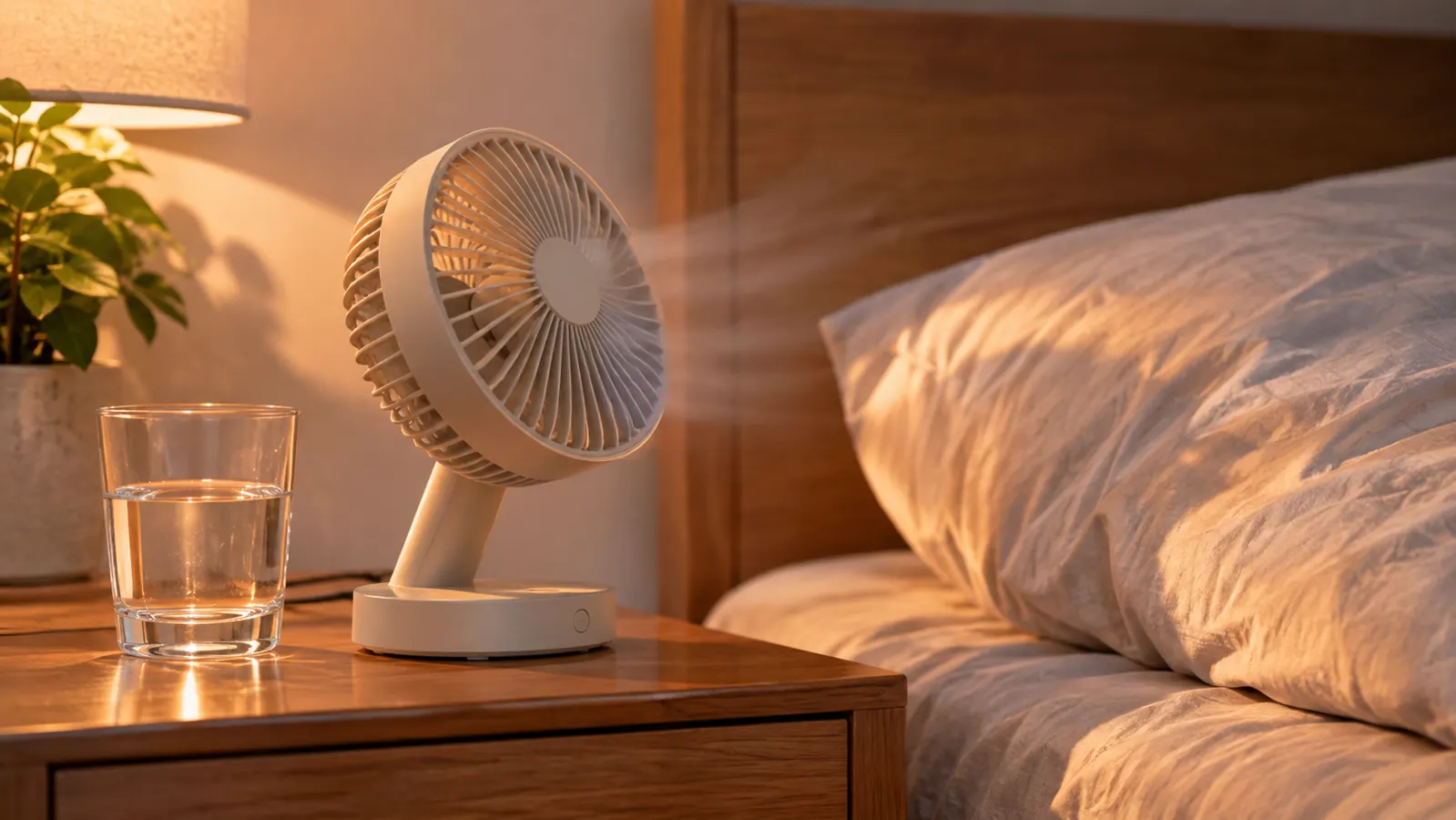
The fan was the first thing I bought, back in April, before the air conditioning season even started. It is a Honeywell TurboForce air circulator, the small HT-900 tabletop model. It sits on my nightstand pointed at my pillow and chest, with a pivoting head so I can aim it without moving the base. There are three speeds and the controls are buttons on the unit itself. No remote, no timer, no oscillation. That sounds like a limitation and mostly it is not, because the fan is two feet from my face.
I run it on low most nights. Low is enough to feel air moving across my chest and it does not keep me awake. When a sweat hits, I reach over and bump it to medium, lie there until I cool down, then bump it back. High exists. I have used high maybe three times, all of them in June, and I turned it back down because the noise was worse than the heat.
Here is the part that took me a month to figure out. Point it at your head and chest, not at the ceiling and not across the room. Moving air over the parts of you that are flushed is what makes the difference. A fan aimed at the wall just makes noise and a faint rattling sound that Ray will mention at breakfast.
A nightgown will not stop a night sweat. It decides whether the next twenty minutes are you lying in a wet shirt or you getting back to sleep.
Step 4: Get your head out of the heat trap
Your pillow is where the heat collects, because your head and neck are what sweat first. My old pillow was solid memory foam and it held heat like a brick. I would flip it four or five times a night looking for a cool patch that was not there.
The SUPA MODERN set I bought in late May is a queen pair, shredded memory foam with microfiber fill, and the important part is the zipper. You can take fill out. I pulled out a handful from mine and it dropped about half an inch, which was enough to stop it pushing my neck up. The cover is dual sided, one cooling side and one soft side, and the cover comes off to wash. The fill does not. I use the cooling side. Ray uses the other pillow on its soft side and has never once mentioned it, which is his version of a good review.
I wash that cover every other week with the sheets and it has held up fine. The whole thing is lighter than my old foam pillow, so when I do wake up hot, I can shove it aside instead of wrestling it. Small thing. At 2 a.m. it does not feel small.
Step 5: Decide in advance what you will do at 2 a.m.
The last step is not a product. It is a decision you make before bed so that the 2 a.m. version of you does not have to be clever.
When I wake up hot, I get up. Lying there waiting to cool down does not work for me and it never did. I stand in front of the fan for a minute or two, drink half a glass of water, and if the nightgown is actually damp I change into the spare one hanging on the hook behind the bedroom door. Then I get back in. The whole thing takes under fifteen minutes and I am usually asleep again before the clock rolls over.
What I do not do is turn the thermostat down. That wakes Ray, he gets cold, he turns it back up, and now we are both awake and irritated. I also do not check my phone. The light resets everything and I have learned that the hard way more than once.
What Else Helps
A few small things support the rest. I keep a glass of water on the nightstand and a folded towel in the drawer, because a damp pillowcase at 3 a.m. is worth changing and takes ten seconds. The room stays dark and my phone charges in the kitchen. I go to bed around 10 and I am up at 5:45 on school days, so the window is not generous and I do not spend it scrolling.
Two more that cost nothing. I take a lukewarm shower before bed instead of a hot one, because a hot shower leaves me flushed for an hour and I have paid for that mistake. And I make the bed with the top sheet pulled up and the blanket folded at the foot, so I start the night cooler and add layers if I need them. Starting cool and warming up is much easier than starting warm and trying to cool down at midnight.
The one thing I will say clearly: this is a comfort setup, not a treatment. A cooler bed and a lighter nightgown make the wake-ups easier to get through. They do not reduce how often they happen and they do not fix anything underneath. If you are waking up soaked most nights, or the sweats came on suddenly, or they are bleeding into your days, talk to your doctor about perimenopause and what your options are. That conversation is worth more than everything on this list and it is not one I can have for you.
The one change I would make first
If you only do one thing, change the layer against your skin. The GYS nightgown is short sleeve, V-neck, above the knee, and pulls on in the dark. It will not stop the sweat. It will not hold it against you either.
Amazon Check Today's Price on Amazon →