

The clock said 2:07 a.m. and I was lying on top of the covers with my heart going and the back of my nightgown soaked through. It was early April in Tucson, the week before we turn the air conditioning on for the season, and the house still held the afternoon heat like a brick oven. Ray was beside me under his fleece blanket, comfortable, breathing the way people breathe when they are not awake. I got up, changed, came back, and lay there staring at the ceiling until a little after four.
If you have been through this, you know the drill. I tried everything that gets passed around at work. Cracking a window. Sleeping in an old cotton t-shirt. Kicking one leg out from under the covers. None of it did anything except make me cold for four minutes and then hot again. The room was not the problem and the bedding was not the problem. The problem was that at two in the morning my body ran a small furnace and there was no moving air anywhere near it. So in April I bought a Honeywell TurboForce air circulator, the small tabletop one, and set it on my nightstand.
I want to be straight with you about what this is. I am not going to tell you a fan stops hot flashes. It does not, and I would not trust anyone who says otherwise. I have talked with my own doctor about what my body is doing and I would tell you to do the same. What I am writing about is smaller and more useful than a cure. It is the air in the room, and what happened when I finally changed it.
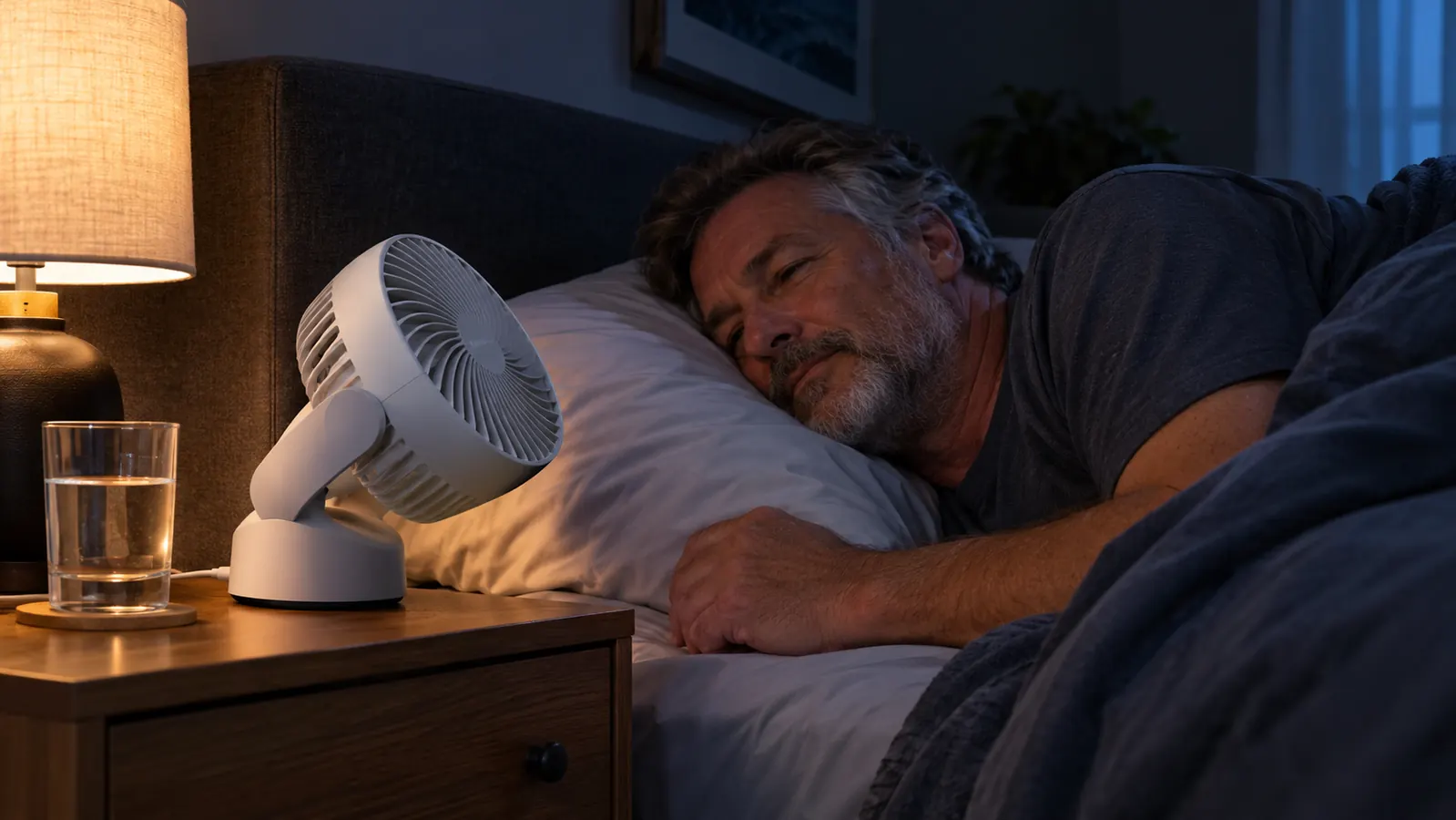
Here is what the Honeywell TurboForce actually is. It is a small fan, 2.6 pounds, roughly the size of a hardback book, and it sits on a nightstand without taking the whole thing over. It has three speeds and button controls on the unit, so there is nothing to hunt for in the dark at two in the morning and nothing to lose. The head pivots 90 degrees, which turned out to be the part that mattered most. I can point it at my chest instead of my face.
The first night I ran it on low. I heard it for about a minute and then I stopped hearing it, the way you stop hearing the refrigerator. I did not get up again. I woke at 5:40 instead of 4:15, and I will admit I lay there for a second feeling oddly emotional about a fan.
I did not get up again. I woke at 5:40 instead of 4:15, and I will admit I lay there for a second feeling oddly emotional about a fan.
What Actually Got Me Back to Sleep at 2 A.M.
The Honeywell TurboForce HT900 sits on my nightstand, runs on low, and keeps air moving across my chest. Three speeds, button controls on the unit, a head that pivots 90 degrees. Nothing to program at two in the morning.
Amazon Check Today's Price on Amazon →Three months later, that is still the routine. Low most nights. Medium when I feel one coming on and I want the air moving harder across my chest. High almost never at night, because high is louder than I want in a bedroom and I am a light sleeper to begin with. On the bad nights I run it on medium until the wave passes, then reach over and press it back down to low without opening my eyes.
The pivoting head is the part I did not expect to care about. Aimed straight at my face, the fan dries my eyes and my mouth and I wake up feeling like I slept in a parking lot. Angled down toward my chest and the pillow, it does something different. It keeps a small pocket of moving air right where the heat starts, and I can lie still instead of thrashing around hunting for a cool patch of sheet.
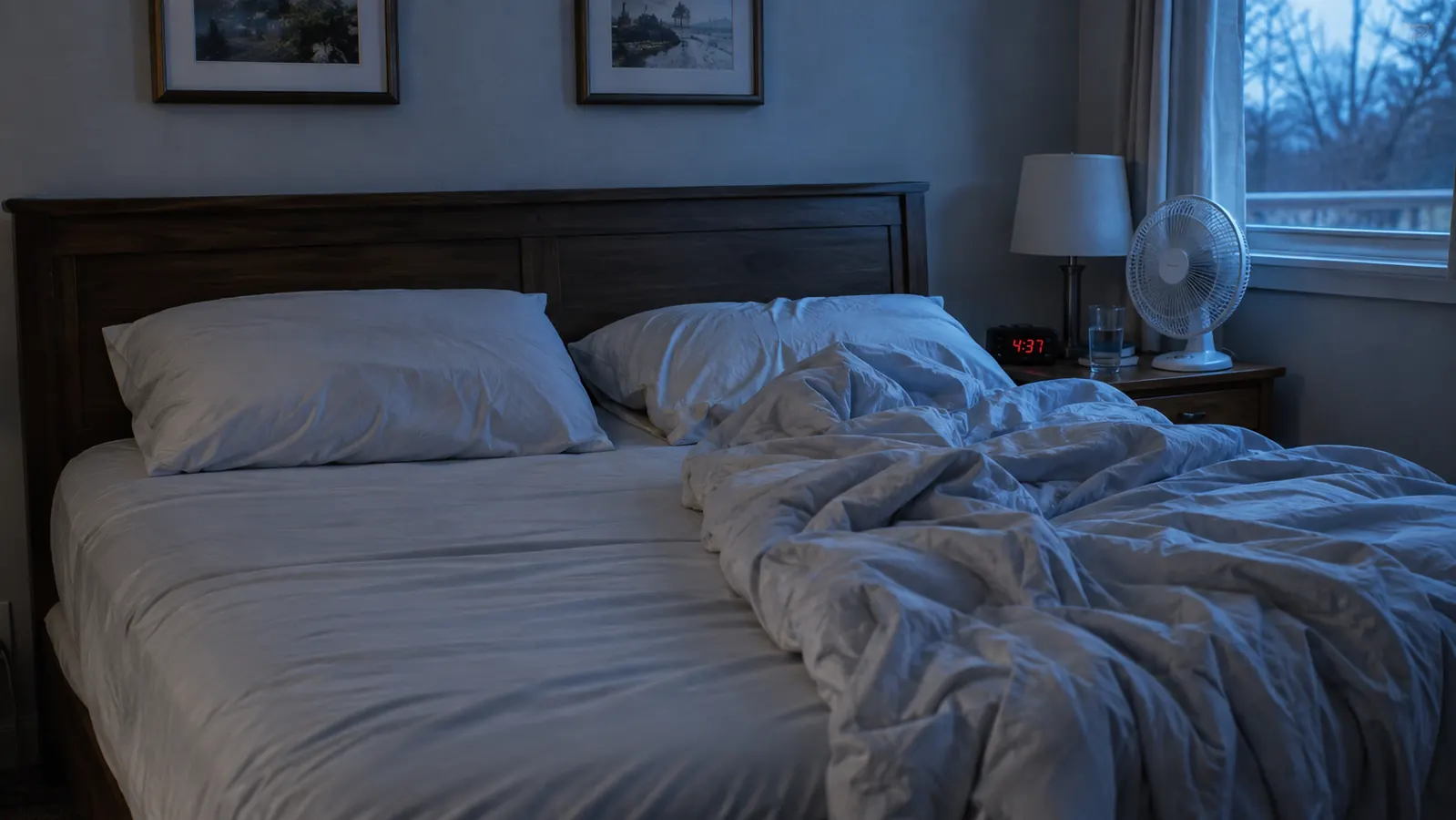
What the Honeywell TurboForce does not do: it does not cool the bedroom. It is not an air conditioner and it does not lower the temperature of anything. It moves air, and moving air is what my body needed. It is also not silent on the high setting, and it is one more cord to deal with behind the nightstand, which I notice every time I dust. Ray barely registers it, which is either a selling point or a disappointment depending on what you are hoping for.
The rest of the setup is unremarkable. Ray keeps his fleece on his side. I keep my own top layer light and folded so it covers only me. The thermostat sits around 72 because Ray gets cold and I would rather it was lower. The fan is the piece that made the difference between lying awake and going back to sleep, and it was the smallest and least dramatic thing I tried.
I also want to say the obvious thing, which is that some nights it does not work. I still wake up hot most weeks, sometimes twice. The difference is what happens next. Before, a hot night meant an hour and a half of lying there rehearsing tomorrow's problems. Now I reach over, press a button, and I am usually back out inside fifteen minutes. That is not a cure. It is a much better two in the morning.
What I'd Tell You If We Were Sitting at My Kitchen Table
If you were at my kitchen table with a glass of iced tea, here is what I would say. You are not broken and you are not failing at sleep. Your body is doing a thing that plenty of bodies do at this age, and it is worth talking to your doctor about, because there are real treatments and I am not one of them. What I can tell you is that the room matters more than I assumed. One small fan on the nightstand, pointed at your chest, on low, is a ten minute change you can make tonight.
And I would tell you not to buy five things at once. I did this backwards for a while, swapping sheets and blankets and pillows all in the same month, and I could not have told you which one helped. The Honeywell fan was the first thing I bought and the only thing I am completely sure about. Start there. If you sleep better, you will know exactly why, and you will not have spent a season guessing.
Start With the Nightstand, Not the Whole Bedroom
One small fan, aimed at your side of the bed, is the first change I would make again. Low speed, head tilted toward your chest, close enough to reach from the pillow. That is the whole setup.
Amazon See the Honeywell TurboForce on Amazon →