

The night I ordered the Honeywell TurboForce air circulator, I woke up at 2 a.m. with my nightgown stuck to my back. It was early April, a couple of weeks before we give in and turn the air conditioning on for the season, and the bedroom still held the whole afternoon's heat because it faces west. I swung my legs out from under the covers and lay on top of the sheet with my arms out, like a snow angel in reverse, waiting to stop feeling like I had a fever. Ray was asleep beside me under a fleece blanket. That is not his fault. It is just the arrangement.
I am 51. I work the front office at an elementary school, I am up at 5:45 on school days, and I have been waking up hot at night since I was about 49. Most nights it happens once, sometimes twice. Before this fan, the routine was always the same: wake up hot, lie there hoping it passes, give up, walk to the kitchen, drink water, come back, and lose somewhere between 45 minutes and an hour of sleep I never get back. I had already tried lighter bedding and fewer covers and sleeping in an old t-shirt. What I had not tried was moving air pointed at me personally, which turns out to be a different thing from a ceiling fan stirring the whole room. Honeywell sells this one as a small tabletop air circulator, and after running it every night since April, here is what I can tell you straight.
The Quick Verdict
Quiet enough on low to sleep through, strong enough on medium to break a hot flash, small enough to share a nightstand with a lamp and a water glass. It moves air at you. It does not cool the room, and it does not stop the waking up.
Amazon Check Today's Price →The small fan that buys me back the hour after I wake up hot
Three speeds, a head that pivots 90 degrees, and a footprint about nine inches wide. It has been sitting on my nightstand since April.
Amazon Check Today's Price on Amazon →How I've Used It
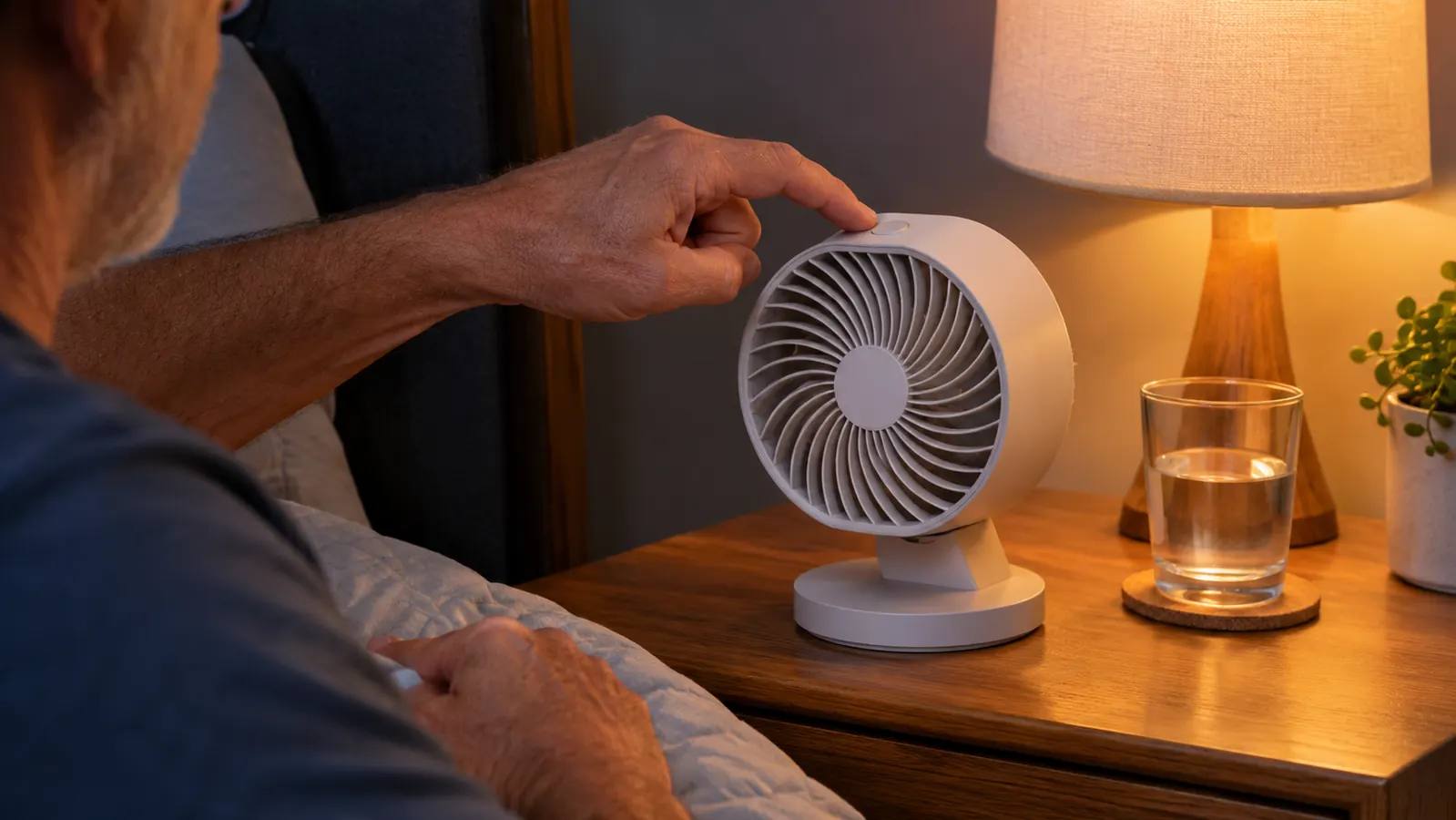
The TurboForce is the oldest thing in my current nightstand lineup. I bought it in April. It sits on my nightstand a foot or so from my pillow, angled down toward my chest, and it has run almost every night since. The Honeywell HT-900 is the small tabletop model, about eleven inches tall and just under three pounds, so it does not crowd out the lamp, the water glass, and the paperback I keep pretending I will read.
For the first week I ran it on high, because that is what you do with a new thing. High is too much for sleeping. It is loud enough that I notice it, it dries my eyes out, and by morning my throat feels like I have been sitting in a draft, which I have. Now it runs on low from the time I get into bed around ten until I get up at 5:45. When a hot flash hits, I reach over and press the button for medium without opening my eyes, and somewhere in the next five to fifteen minutes I press it back down to low.
The controls are three physical buttons on the unit itself, one per speed. There is no remote, no timer, no oscillation, and no app. You walk over and press a button. I expected to find that annoying and I did not. The last thing I want at 2 a.m. is a phone screen lighting up the room while I fumble for an app. Setup took about two minutes: out of the box, cord into the outlet behind the lamp, press a button. If your only outlet is across the room from the bed, check the cord length before you buy rather than after.
The Three Speeds, and Which One I Actually Use
Low is quiet. Not silent, but quiet enough that after three or four nights my brain stopped hearing it. It is the sound of air moving, a little like a box fan two rooms away. Ray has never once complained about it, and Ray complains about plenty, including the ceiling fan in the living room, which he says wobbles.
Medium is the setting that earns the fan its place. This is what I hit when I wake up with my heart going and the sheet stuck to me. The air moves across my chest and neck right away, and that immediate sensation is the part that helps, because the heat I feel is mostly on my skin. It is noticeably louder than low. I can still fall asleep on medium if I am tired enough, but I would not choose it for eight hours.
High is for daytime. I have used it at night maybe three times, all of them in June, and every time I turned it down within twenty minutes. High moves a lot of air and it lets you know it is doing it. If you need loud white noise to drown out a house, you may like it more than I do. For sleeping, low and medium are the whole product.
What the Pivoting Head Does in a Shared Bed
The head pivots 90 degrees, so it can point down at the bed, straight ahead, or up toward the ceiling. Mine is tilted down maybe 20 degrees so the air lands on my chest and face and skips over Ray entirely. That sounds like a footnote and it is really the reason this fan works in a bed with two people in it. Ray sleeps under a heavy fleece blanket in the same room where I am trying to shed heat. A fan that swept the whole room would bother him. A fan pointed at me does not.
It pivots and then it stays where you put it. It does not sweep back and forth. If you want a fan that oscillates across the bed, this is not that fan, and I would rather tell you now than have you find out in July. It is a personal fan: one person, one direction, one pillow. The Honeywell is built for that, not for cooling a whole bedroom, and once I stopped asking it to do the second thing I liked it a lot more.
One adjustment was worth making. Aimed dead at my face, it dried my eyes out by morning. Aimed slightly across my chest and past my cheek, I get the same cooling and no dry eyes. If you try this fan and wake up with scratchy eyes, move it four inches before you give up on it.
The Noise, Honestly
I am not going to hand you a decibel number. I did not measure one, and I do not trust a number I cannot check. What I can do is compare it to things you already know. On low it is quieter than the exhaust fan in the hall bathroom, quieter than the refrigerator, and it disappears under the sound of the central air, which in our house runs most of the summer. In a completely silent room it is audible. In a normal bedroom it is background.
On medium it becomes the loudest thing in the room. I can sleep through it. I would not want it as a permanent setting. On high it is loud enough that I would have to raise my voice to talk to someone on the other side of the bed, which is one more reason high stays a daytime setting. If you need absolute silence to fall asleep, no fan is going to give you that, and this one is not the exception.

What It Doesn't Do
It does not cool the room. It is a fan, not an air conditioner. It does not lower the temperature, and if you set a thermometer next to it the thermometer will read exactly what it read before. What it does is move air across your skin, which is how your body gets rid of heat. That is why it helps me, and it is also why it will not help everyone equally, especially somewhere humid where moving air does less.
It does not stop night sweats. I still wake up hot. I want to say that plainly, because I read plenty of reviews promising a full night's sleep and I do not believe a fan can promise that. What changed is what happens after I wake up. Before, I lost close to an hour. Now I turn the fan to medium, lie back down, and I am usually out again inside ten minutes. Some nights it is faster than that. Some nights I still end up in the kitchen. Most nights I do not.
It does not cool Ray's side of the bed, and it does not cool the room for the morning, and it is not going to replace the air conditioning in a Tucson July. It handles about two feet around my pillow. That is the job I bought it for, and it does that job every night.
Cleaning It, and the Small Annoyances
Every couple of weeks I wipe the front grille and reach through it with a microfiber cloth to get the blades, and that is the entire maintenance routine. It takes five minutes. I do it on a Saturday while the sheets are in the wash, because that is when I remember things like that. I would not call it a chore, but I would not call it nothing either, and in a desert house a fan collects dust fast.
The annoyances are small and I will list them anyway. The buttons are on the unit, so a middle-of-the-night adjustment means reaching. There is no timer, so it runs until I turn it off at 5:45. It is plastic, and after months of nightly use the housing has picked up a faint rattle on high that was not there in April, though low sounds exactly the way it did on day one. None of that has made me want to put it in the closet.
What I Liked
- Three speeds that are genuinely different from each other
- The 90 degree pivoting head aims air at one person instead of the whole bed
- Quiet enough on low to sleep through, night after night
- Small footprint, about eleven inches tall, so it fits a crowded nightstand
- Plain buttons, nothing to pair, nothing to update, nothing to charge
Where It Falls Short
- No timer, no remote, and no oscillation
- Noticeably loud on high
- Corded, so you need an outlet reasonably close to the bed
- Moves air, does not cool the room, and does not stop the waking up
- Dust builds up on the grille and the blades quickly in a dry climate
I still wake up hot. What changed is what happens next: before the fan I lost an hour of sleep a night, and now I am usually back under in ten minutes.
Who This Is For
This is for you if you wake up hot and you have already made the covers as light as they can go. It is for you if you share a bed with someone who sleeps cold and you are tired of negotiating the thermostat at 2 a.m. It is for you if you have a nightstand within arm's reach and an outlet behind it. And it is for you if what you want is air on your skin rather than the entire room cooled down, because those are two different purchases. One more thing, and I mean it: nothing here is medical advice. Talk with your doctor about your symptoms and what to do about them. A fan is a comfort item. It is not a treatment.
Who Should Skip It
Skip it if what you actually want is a colder room, because this will not do that and you will be disappointed in week one. Skip it if you need oscillation, a remote, or a timer, since it has none of those. Skip it if you need silence to fall asleep, or if your nightstand is already full, or if the only outlet is across the room. And skip it if you are hoping a fan will end the night sweats, because it will not, and I would rather you hear that from me than from a product page. What it will do is put moving air on your face at 2 a.m. without waking the person next to you, and for me that has been worth the space on the nightstand every single night since April.
One small fan, and most nights I get that hour back
It will not cool the room and it will not stop the hot flash. It will point moving air at you at 2 a.m. and leave everybody else in the bed alone.
Amazon Check Today's Price on Amazon →