

Nobody warns you that the worst part of waking up hot at 2 a.m. is the ten minutes afterward, when you are lying on top of the covers in the dark, waiting to cool down enough to be sleepy again. That was my April. The air conditioning had not been switched over for the season, the west-facing wall of our house was still giving back the afternoon heat at midnight, and I had already tried everything sensible. What finally helped was small, unglamorous, and fit on a nightstand that already held a lamp, a glass of water, and a book. It was a Honeywell TurboForce air circulator, the little HT-900 tabletop model, and I have run it almost every night since.
This is not a sponsored post and I did not get a free fan. I bought this one in April, it has been on my nightstand every night since, and I have a few opinions that would not survive a marketing meeting. If you are here because you wake up hot and cannot get back to sleep, you are in the right place. If you are here for a number that says the fan cools a bedroom by so many degrees, I do not have one, and neither does anyone being straight with you.
The Quick Verdict
Small, genuinely effective on a nightstand, and honest about being a fan. High is too loud to sleep through and it will not cool a room.
Amazon Check Today's Price →The fan on my nightstand is the boring one, and it works
Three speeds, a pivoting head, and a footprint small enough to live beside the lamp. This is the HT-900 I have run every night since April.
Amazon Check Today's Price on Amazon →The Night That Started It
Early April in Tucson is a trick. The days reach the low nineties, the nights fall into the sixties, and the house never quite catches up, so by bedtime the bedroom is holding heat it collected at four in the afternoon. Our bedroom faces west, which means the wall soaks up the sun all day like a baking stone and radiates it back at us until well past midnight.
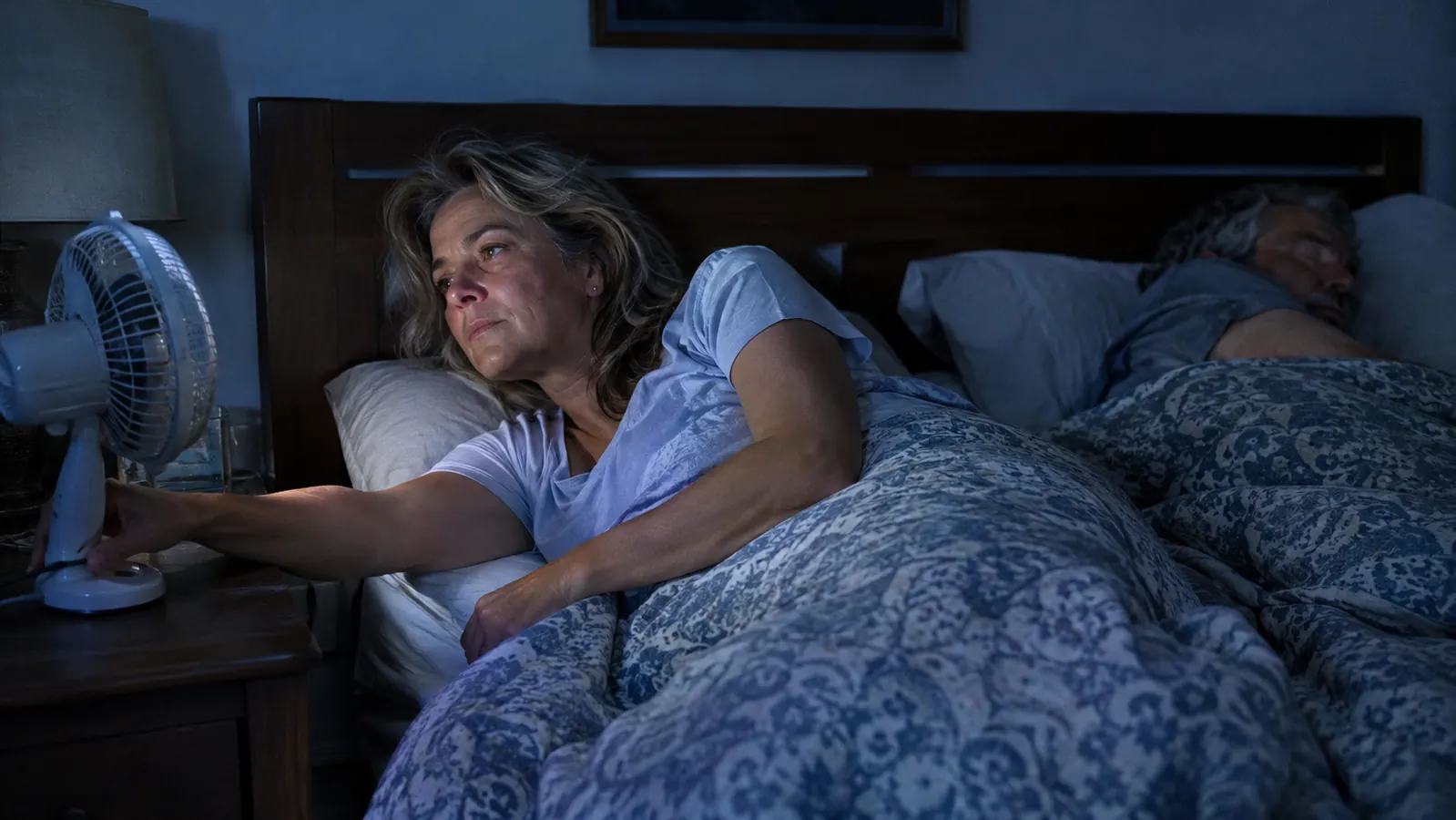
Ray had the thermostat at 72, because he sleeps cold and likes a heavy blanket, and I had stopped arguing about it, because arguing about the thermostat is the least productive hobby in any marriage. The night I remember, I woke at 2 a.m. soaked through my t-shirt and lay on top of the covers for a long time with my arms out, which is what I had been doing for weeks. I could feel the heat coming off my own pillow. What I thought, very clearly, was that I was tired of solving this with willpower.
Before the fan, I tried the things you try. I slept on top of the covers under the flat sheet alone, which worked until about 3 a.m., when I got cold and pulled everything back up and undid the whole thing. I kept a damp washcloth on the nightstand and pressed it to the back of my neck, which bought me four minutes. I opened the window one week in March, got a face full of dust and a moth in the bedroom, and shut it again. None of that was stupid. None of it lasted past the first hot week.
The fan went on the nightstand about a week later. It has been there ever since, through the whole summer, and it is the only thing I bought this year that I would replace the same day if it broke.
How I've Used It Since April
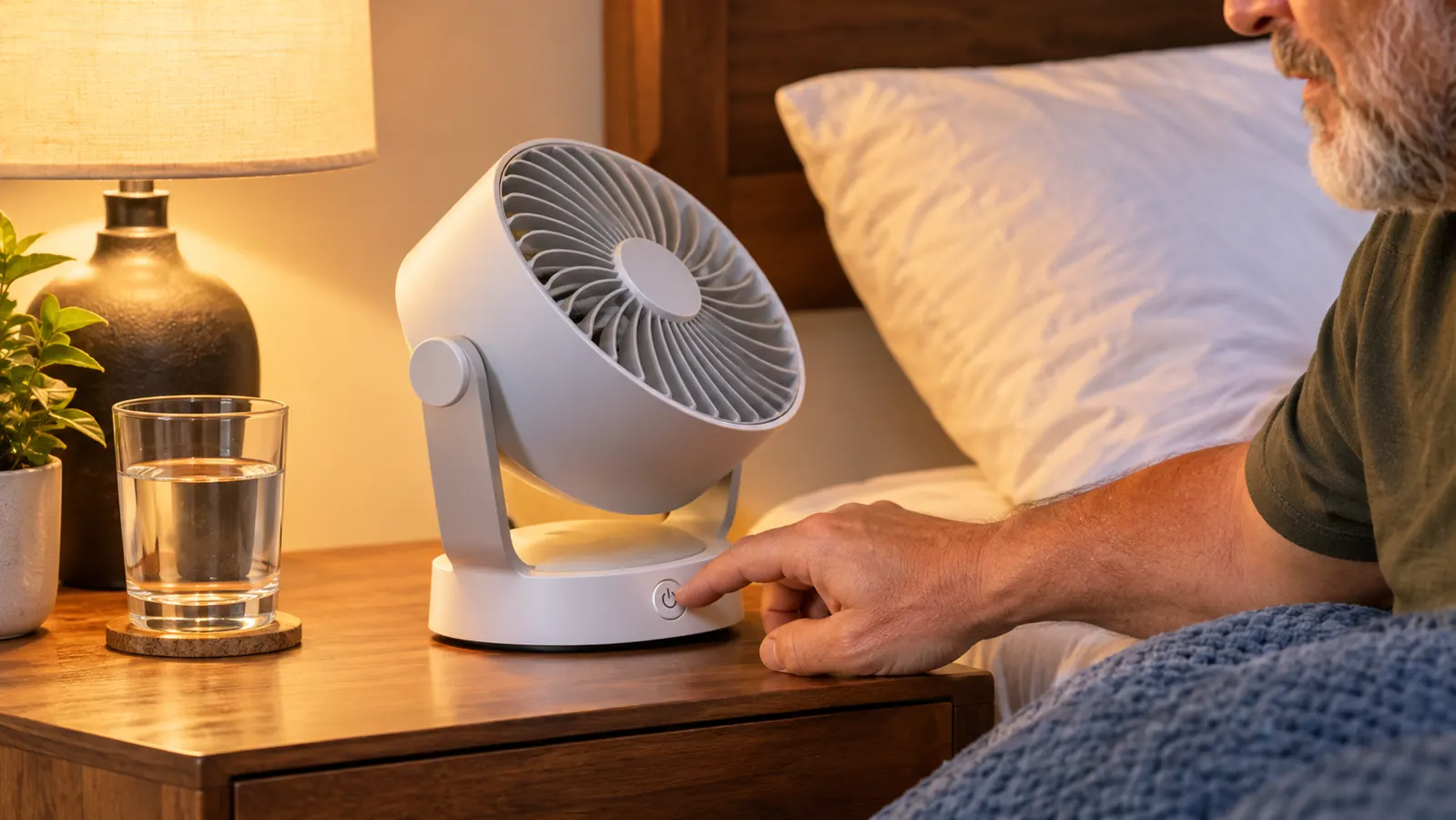
The fan sits on the nightstand, angled up toward my pillow and my chest. Low is what I run all night. It is enough to break up the still air right around my face, which turns out to be the part that matters, and it is quiet enough that I stopped hearing it by the second night. When I wake up hot, I reach over and press the button once to move it to medium, hold the pillow up for a minute or two, and let the heat pass. That is the entire system. It is not sophisticated and it has worked better than anything else I have tried in two years.
I wrote the date on the calendar, which sounds excessive, but I wanted to be able to tell you something true instead of something vague. First night was April 9. I measured the gap with a tape measure because I am that person, and the front of the fan sits 26 inches from the edge of my pillow. Close enough that on low I feel it on my forehead and my chest, far enough that I am not lying in a wind tunnel. The one night I skipped it, in early June, I fell asleep on the couch during a ballgame, woke at 11:30, and went to bed without turning it on. I knew by 1 a.m. that I had made a mistake.
The 90 degree pivoting head does more work than I expected. I keep it tilted up at the pillow rather than aimed flat across the room, and I adjust it most mornings when I make the bed. If I am sitting up reading at 9:30, I tip it down toward my face. When I lie down, I tip it back up. It holds where you put it, and that sounds like a small thing until you have owned a fan whose head sagged under its own weight and spent the night blowing at the floor.
The button is on the front of the unit, which matters more than it should at 2 a.m. I can find it in the dark without knocking over the water glass or turning on a light. There is no remote and no timer. I do not miss either one, because the fan is two feet from my head and I am the timer.
The fan does not cool the room. It cools me, in the one spot where I am actually lying, which is the only place that ever mattered at 2 a.m.
What Nobody Tells You About a Small Fan
Honeywell calls this a circulator, and it is worth understanding what that word is doing. This is not an air conditioner and it does not lower the temperature of anything. It moves air. Air moving across your skin helps moisture evaporate, and evaporation is what actually makes you feel cooler. That is the whole mechanism. It is also why placement matters more than power, and why a fan pointed at a person beats a fan pointed at a ceiling every time.
The listing puts the airflow at 185 cubic feet per minute and says you can feel it from up to 25 feet away. In a bedroom, that distance is beside the point. My nightstand is roughly two feet from my pillow. What matters at that range is that the lowest setting is gentle enough to sleep under, and that the fan does not have to be aimed with surgical precision. Both are true.
What nobody tells you is that the fan is only half the purchase. The other half is where you put it. My first week I had it on the dresser across the room, because that was where the outlet was, and I was lukewarm about the whole thing. Moving it to the nightstand and tilting it at my pillow was the difference between owning a fan and solving a problem. If you buy one, set it across the room, and shrug, you have not really tested it.
The listing also names wall mounting as an option. I have not tried it and cannot tell you how that holds up on drywall in an old house like ours. What I can tell you is that the cord, not the fan, decides where it lives. Measure your outlet before you get clever about the arrangement.
The Three Speeds Are Not a Volume Knob
Three speeds sounds like a narrow range until you live with it. Low is a soft moving-air sound that I stopped noticing quickly. Medium is audible, not painful, and I would not choose to fall asleep to it, but it is exactly right for the five or ten minutes of a hot flash. High is loud enough that I have to raise my voice to talk to Ray across the bed. I use high in the daytime when I am folding laundry in that room, and almost never at night.
Here is a real night, so you can calibrate. Late June, the low was still 88 at midnight, and I woke at 1:40 with my t-shirt stuck to my back. I reached over, pressed the button twice, and lay back down under medium with the head tilted at my chest. I was comfortable enough to stop thinking about it in about three minutes, and I fell back asleep before 2:15. I did not need high. I have needed high exactly twice since April, both times when I came in from the garage at dinnertime and the bedroom was still holding the afternoon, and neither of those had anything to do with sleeping.
The practical result is that I use two of the three speeds for sleeping. If you are someone who needs a strong breeze all night, be honest with yourself about that before you buy. This is a small tabletop fan, 10.9 inches tall and 2.6 pounds, with a 35 watt motor. It is not going to move the air in a whole room the way a larger fan will, and it is not supposed to.
The Noise Question, Honestly
People ask whether it is quiet, and the listing says 25 percent quieter than comparable fans, which is a comparison neither of us can check. What I can tell you is what it sounds like in a real bedroom with the air conditioning running and a husband who snores mildly. On low, I do not hear it over the air conditioner. On medium, I hear it and I do not care, because I am hot. On high, I hear it and I care.
Ray's review, for what it is worth, is that low is fine and medium is annoying. He is the one sleeping cold under a fleece blanket, so take that as you like. He has not once asked me to turn it off, and after four months of nightly use I consider that a real endorsement. There is one more noise note worth having. When the air conditioning cycles off in the middle of the night, the fan is the only thing running in that room, and on low it becomes the loudest object in the house. It is a soft sound, closer to a breath than a hum, but it is there. If you need dead silence to fall asleep, this is not dead silence.
What I Liked
- On low, two feet from a pillow, it is enough to fall asleep under
- The 90 degree pivoting head holds its position all night instead of sagging
- The button on the front of the unit is easy to find in the dark without a light
- Small footprint, 6.3 by 8.94 inches, on a nightstand that already held a lamp and a water glass
- Run every night since April with no rattle, stall, or fuss
Where It Falls Short
- High is too loud to sleep through in a quiet bedroom
- No oscillation, so the air lands in one spot unless you move the head
- No remote and no timer, so you reach over to change anything
- It moves air and does not cool a room, which will disappoint anyone expecting air conditioning
What It Does Not Do
It does not cool the bedroom. I want to be plain about this, because the internet is full of people claiming a fan dropped their room temperature by an impressive number. A fan moves air. It does not remove heat from a room. Close the door on a July afternoon, run this on high for an hour, and the room will still be hot. It will simply have air moving through it, which is a different and smaller thing.
It does not stop night sweats. Nothing on my nightstand stops them. What the fan does is shorten the miserable stretch between waking up hot and being able to fall back asleep, and it shortens it a lot. If you are looking for something that prevents the waking up in the first place, that is a conversation for your doctor, not for a product page. I have had that conversation with mine and I would push you to have it with yours.
And it does not help Ray. He sleeps under a fleece blanket on his side of the queen bed and he is perfectly happy. That is worth knowing if you share a bed, because this is a personal fan, not a bedroom fan. It cools one person at a time. In our room that is exactly what was needed. In yours it might not be.
One more thing I will not claim. I have read that a small fan can let a household lean on the air conditioning less, and I have no doubt that is true somewhere. In mine it is not a measurable thing. Ray sets the thermostat and I do not touch it. Do not buy this expecting to see it show up on your electric bill as a line item.
Who This Is For
If you wake up hot once or twice a night and lie there waiting to cool down, this is the simplest thing I can point you at. It suits a nightstand. It suits a person who wants to reach over in the dark, press one button, and go back to sleep instead of getting up and wandering the house. It suits a bedroom where the thermostat is a negotiation you have already lost to someone who sleeps cold.
It also suits a desk in a warm office, or the chair you sit in every evening that never seems to get any air. The Honeywell HT-900 is a small tabletop fan. It goes where you are, and it works best about two feet from your face.
Who Should Skip It
Skip it if you want to cool a whole room. This fan cools the person in front of it. If you want air sweeping across the bed rather than landing on your face, you want a larger fan or a tower fan, and you want to accept that it will take up floor space you may not have.
Skip it if you need oscillation. The head pivots and stays where you put it, which means the airflow lands in one place all night. Some people love that and some people find it claustrophobic. Skip it if you want a remote or a timer, too. There is a button on the unit and that is the entire interface.
The one thing I would not skip is the placement. If you buy this and leave it across the room, you will write a lukewarm review, and the fan will deserve better than that.
Four months in, it has not rattled, stalled, or needed anything from me except a wipe with a dry cloth when it collects dust. I unplug it when we travel and plug it back in when we get home.
What changed is not that I stopped waking up hot. I still do, most nights once, sometimes twice. What changed is that the waking up takes five minutes instead of forty, and I go back to sleep in my own bed instead of standing in the kitchen at 2:30 in the morning drinking water and feeling sorry for myself.
The 2 a.m. fix that fits next to the lamp
Three speeds, a tilting head, and a button I can find in the dark without turning on a light. This is the HT-900, and it has run every night since April.
Amazon Check Today's Price on Amazon →