
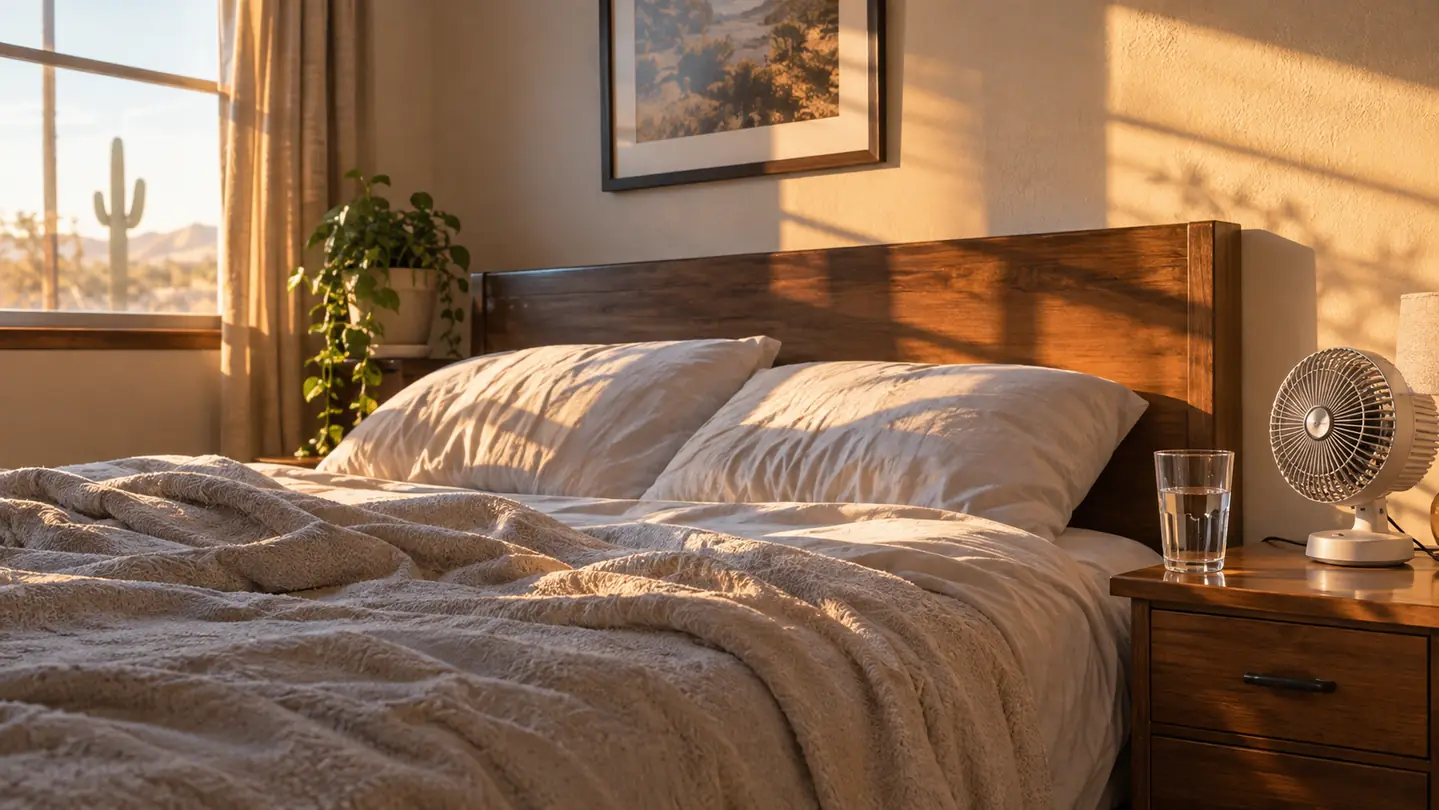
My bedroom faces west. In Tucson, that means the afternoon sun leans on the window for hours, and by 9 p.m. the walls are still holding heat like a brick oven that never got the memo about bedtime. I am 51, I work in an elementary school front office, and I am in perimenopause. My internal thermostat has been unreliable since I was about 49. Most nights I wake up hot once, sometimes twice, and lying there in a warm room makes it worse.
Ray, my husband, is 55 and works in HVAC. He sleeps cold and likes a heavy blanket. Our central air is set around 72 at night because of him. I would rather it was lower, but I also like being married. So I stopped trying to win the thermostat argument and started fixing the air right around my side of the bed. In April, before the air conditioning season really started, I bought a Honeywell TurboForce air circulator, the small HT-900 tabletop model. It sits on my nightstand and points at my pillow and chest. It is not a cure for night sweats. It is a small fan that moves air, and that turned out to be the piece I could actually control.
The fan that made my side of the bed feel like a different room
The Honeywell TurboForce HT-900 is the small tabletop fan I keep on my nightstand. It has 3 speeds and a 90 degree pivoting head, and I run it on low most nights. If your bedroom holds heat and your partner likes the thermostat higher than you do, this is where I would start.
Amazon Check Today's Price on Amazon →Step 1: Stop trying to cool the whole room.
Most of us try to fix a hot bedroom by making the whole room cold. That is a losing game in a west-facing room in Tucson. The sun has been cooking that wall all afternoon, and one small fan cannot undo it. What a fan can do is move air across your skin. That is the part that helps you feel cooler, even when the room temperature has not changed much.
The curtains matter more than the fan during the day. I pull the blinds and close the heavier curtain on that window before I leave for work. If I forget, I can feel it when I walk in at 4 p.m. The room has a stored heat that a small fan cannot erase. What the fan can do is keep that stored heat from sitting on my skin. I also keep the bedroom door open so the hallway air can move through. But I do not expect the room to be cold at 10 p.m. I expect the air to be moving where I am. That is a smaller goal, and it is one a tabletop fan can actually meet.
The Honeywell sits on my nightstand, not across the room. It is pointed at my pillow and chest. It is a small tabletop fan, not a tower or pedestal fan. On low, I can feel it on my face and arms without it blowing papers around. On medium, I feel it more during a hot flash. On high, I almost never use it at night because it is too loud for me. The point is not to blast the room. The point is to give my skin some moving air.
Step 2: Put the fan where it hits you, not where it looks tidy.
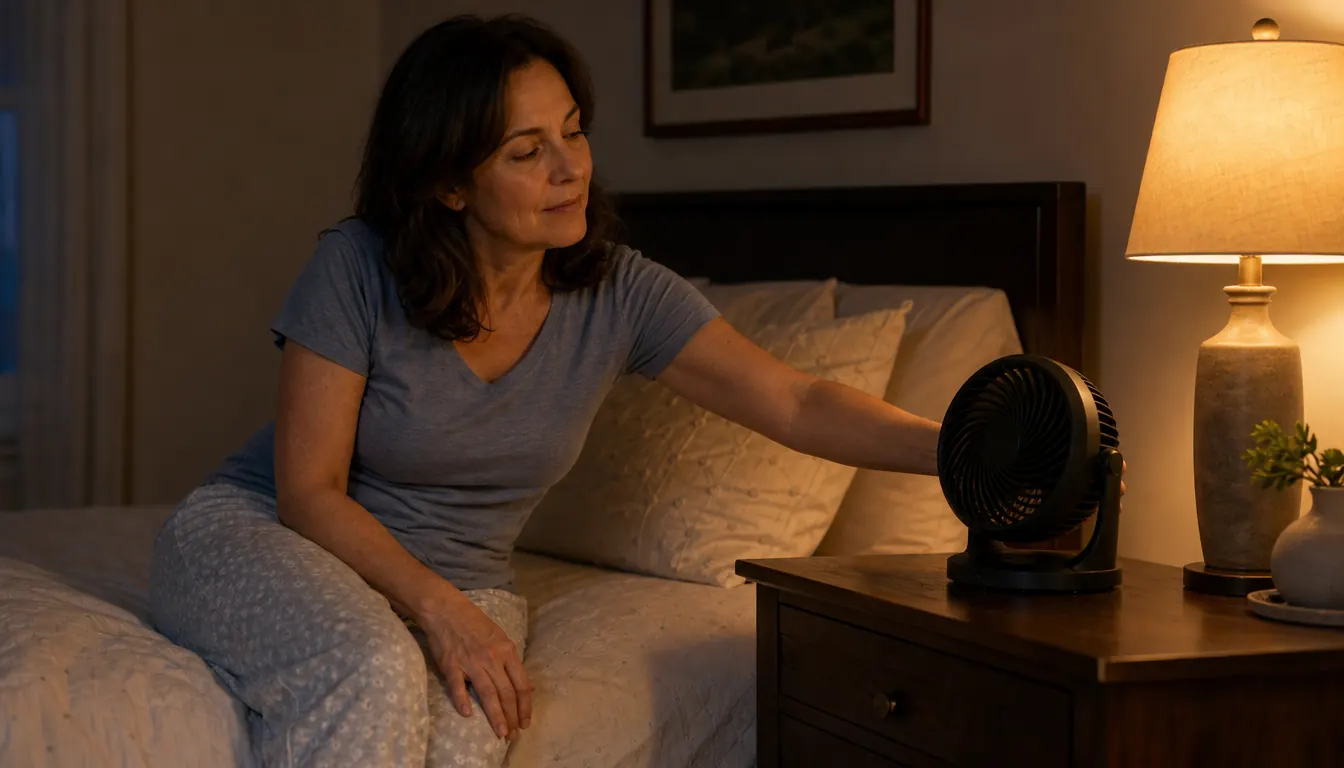
A fan on a dresser looks neat. A fan on the nightstand works better for me. I need the air on my chest and face when I wake up at 2 a.m., not circulating somewhere near the ceiling. The Honeywell has a 90 degree pivoting head, so I can tilt it down toward the pillow without moving the base.
The controls are buttons on the unit. There is no remote, and I do not need one. I reach over and press the button. Low is my normal setting. Medium is for the first ten minutes of a hot flash. High is for the nights when the room has not cooled down at all, and even then I usually turn it back to medium before I try to sleep.
One thing I learned: do not point it at your feet and hope for the best. Point it at your chest and face. That is where I feel the air first, and that is what helps me settle. I also check the angle before I get into bed. If the fan is pointed too high, I feel nothing. If it is pointed at my chest, I feel it right away. That sounds obvious, but I spent the first week with it aimed at the wall because I did not want to mess with the head. If you share a bed with someone who sleeps cold, keep the fan on your side. Ray has never complained about it on low, and he complains about plenty.
Step 3: Fix the layer trap on your side of the bed.
A hot bedroom is only half the problem. The other half is what you are lying under. Ray likes a heavy fleece blanket. I used to lie under the same down-alternative comforter and wake up damp. Now we each have our own top layer. He keeps his fleece. I use a cooling blanket folded in half lengthwise so it covers only my side of the queen bed.
I also changed my sheets in early May to the CGK Unlimited set. They are brushed microfiber, smooth and light, and they do not feel damp and clingy the way my old cotton percale did by 3 a.m. I am not saying they are magic. They are just lighter against my skin. I wash them on Saturday and put them straight back on.
The layer trick matters more than the brand of the blanket. If you are under a shared comforter, you are sleeping under your partner's temperature preference. Give yourself a separate top layer that you can kick off without stealing the covers. That one change made my 2 a.m. wake-ups less panicky, because I had something I could do besides lie there and heat up. I also keep a spare top sheet folded at the foot of the bed. If I wake up and my side feels damp, I can pull the sheet over and not remake the whole bed in the dark. That is not glamorous. It is just easier at 2 a.m.
The fan did not make my bedroom cold. It made the air move across my side of the bed, and that was enough to help me get back to sleep on most nights.
Step 4: Build a wind-down that does not heat you up.
By 9 p.m., I want the bedroom to be as boring as possible. I turn off the overhead light and use a lamp. I put my water bottle on the nightstand. I set the Honeywell on low before I get into bed, so the air is already moving when I lie down. That sounds small, but lying down in still air and then waiting for a fan to save you is a worse start.
I also stopped doing chores right before bed. For me, unloading the dishwasher at 9:30 is enough to make my face hot. I lay out my nightgown and take a few minutes to sit on the edge of the bed with the fan on my chest. I wear the GYS bamboo viscose nightgown, the short sleeve one, because it feels lighter than the oversized cotton t-shirts I used to sleep in. I own two and alternate them. That is not a treatment. It is just a lighter layer.
The goal is to lower the amount of heat you are adding to your own body. Hot drinks, a hot kitchen, a hot shower right before bed, a pile of laundry on the bed. All of it adds up. I am not perfect at this. Some nights I am still answering emails at 9:45. I also watch the clock. If I get into bed after 10:30, I am more likely to wake up hot, because I am already overtired. I aim for 10 p.m. on school nights. I am not always good at it, but it helps.
Step 5: Have a 2 a.m. plan that does not wake the house.
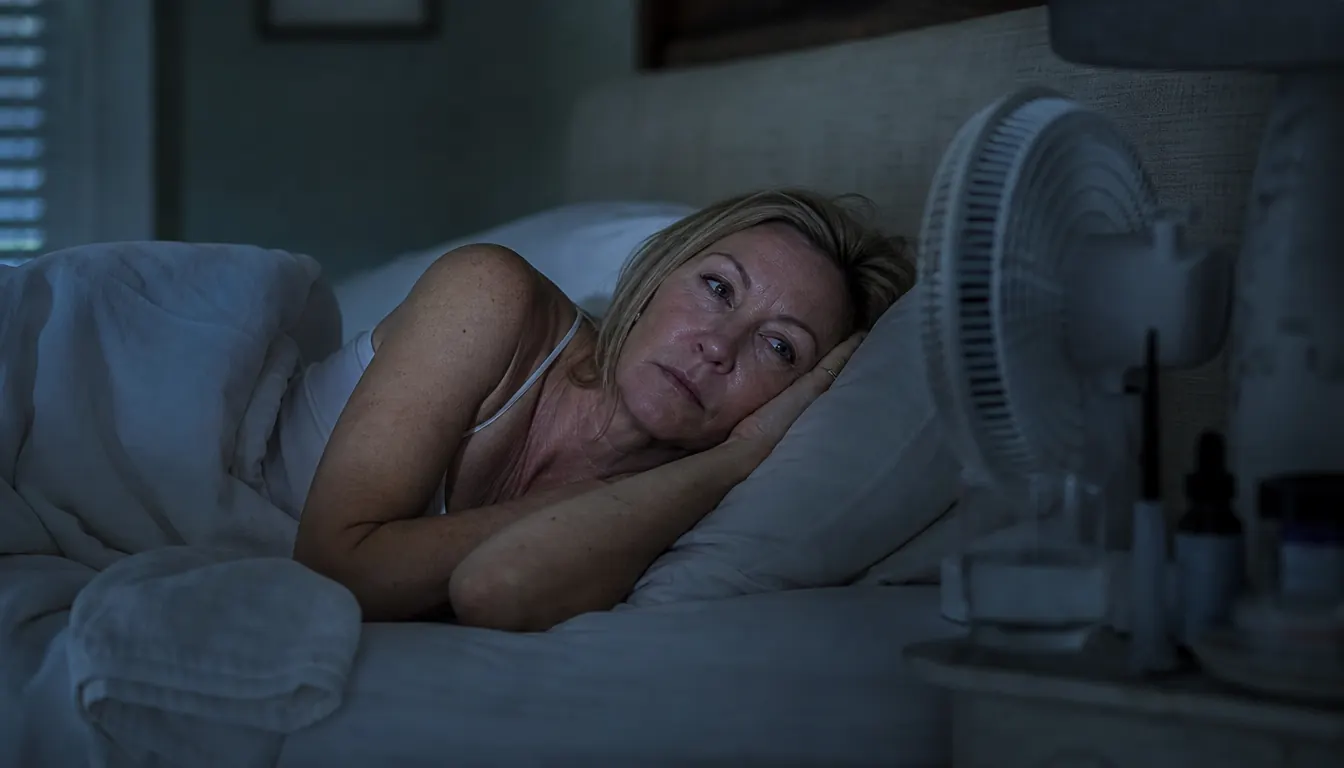
When I wake up hot, my old habit was to lie still and hope it passed. That almost never worked. Now I have a small plan. I sit up, drink water, and press the Honeywell to medium. I let the air hit my chest and face for a few minutes. If I am still hot, I turn it back to low and lie on top of my side of the blanket until I cool down.
I do not turn on the overhead light. I do not change the sheets in the dark. I keep a second nightgown on the hook in the bathroom so I can swap if I need to. The fan is small enough to pick up with one hand, so if I want to move it closer to my face for a minute, I can. I do not use high at 2 a.m. because the noise wakes me up more than the heat does.
The other part of the plan is a time limit. If I am still awake after about 20 minutes, I get up and read in the living room under a lamp. Lying in bed angry about being awake makes the heat worse. I keep the fan on my nightstand, not on the floor, so I do not have to bend down in the dark. I also keep the cord behind the nightstand so I do not trip on it. These are small things, but at 2 a.m. small things matter. I am not a doctor, and I am not telling anyone this will fix night sweats. I talked with my own doctor about mine. This is just what I do in my bedroom at 2 a.m. so I do not wake Ray and so I do not spiral.
What Else Helps
Two other things helped me. The first is a dark room. I close the blinds before I leave for work, and I keep the lamp low at night. The second is a cooler pillow. I use the SUPA MODERN cooling pillow, one of the two from the set, and I took out a handful of the shredded memory foam so it sits lower under my neck. Ray uses the other one on its soft side. I am not going to tell you a pillow stops night sweats. It just gives me one less warm spot to fight.
I also keep the bedroom door open during the day so the heat does not stack up in one closed box. If you have a ceiling fan, use it on low to keep the air moving, but do not expect it to make a west-facing wall cool. And if you are waking up soaked several nights a week, talk with your doctor. A fan and a lighter blanket are comfort tools. They are not medical treatment.
One more thing: I do not chase the perfect bedroom temperature. I chase a bedroom I can sleep in. That means a dark room, moving air, a lighter layer on my side, and a plan for when I wake up. It is not a cure. It is a setup that makes a hot night less miserable.
Start with the air on your side of the bed
The Honeywell TurboForce HT-900 is the small tabletop fan I bought in April and still use every night. It has 3 speeds, a 90 degree pivoting head, and button controls on the unit. It will not cool your whole room. It will move air across you, which is the part that helped me.
Amazon Check Today's Price on Amazon →